

- What is and how buy LinkedIn comments work?
- Where and how to buy LinkedIn comments? 5 common options and the best sites to watch for
- How to choose a provider to buy LinkedIn comments?
- Top 4 legal and effective alternatives to boost engagement (for real)
- How Waalaxy helps leverage this engagement to generate leads
- Conclusion: Buy LinkedIn comments is a shortcut… to what?
- Frequently asked questions (FAQ)
You publish. You craft your headline. You add an image. You finish with a question. And then… the post lands with 2 likes, 0 comments, and reach that feels like shouting into an empty conference room. 🥺
So if you’ve ever typed “buy LinkedIn comments” into Google, that’s not automatically you being dishonest. Most of the time, it’s just frustration, and a hunt for a quick fix to a very human problem: “I’m talking to myself.” 😩
The thing is, on LinkedIn, it’s not just a question of the number of comments. 🚨 They’re a social (and business) signal:
- Does this content spark opinions?
- Does it create a real conversation?
- Does it attract qualified people (prospects, talent, partners)?
That’s where buy LinkedIn comments turns into a bad idea: you can pump up the count… while quietly killing what matters most: trust, network quality, and conversions. ❌
💡 In this guide, we’ll break down how it works (types, pricing, where people buy, how scams show up). But more importantly, we’ll give you the counter-model: how to generate real LinkedIn engagement and then turn that engagement into leads (especially with tools like Waalaxy).
What is and how buy LinkedIn comments work?
💸 Buy LinkedIn comments means paying a third party to post comments under your posts (or under someone else’s account) to make it look like there’s a conversation, mostly to trigger more visibility on LinkedIn.
In practice, there are 4 common methods: 👇🏼
- Comments from random accounts (often the provider’s “network”).
- Comments from fake accounts (risky and easier to detect).
- Comments via pods/communities (engagement swaps, sometimes paid).
- Manual LinkedIn services (freelancers/agencies commenting “by hand”).
Difference between buy LinkedIn comments & use a LinkedIn comments generator
A lot of people mix these up.
- Buy LinkedIn comments: someone else comments for you using other accounts.
- Generating LinkedIn comments: a tool helps you write posts and comments faster (ideas, rewrites, structure)… and to automate the whole thing.
👉 Example: You use a content assistant like Kawaak 🐰 to generate 5 smart comment variations, pick the best one, tweak it to match your voice, and post it yourself.
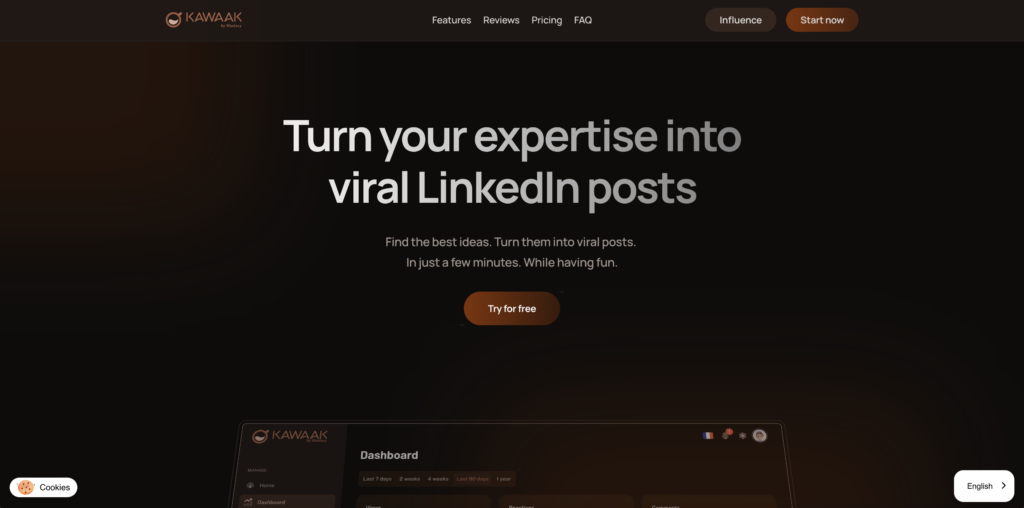
Bottom line: if your real issue is “I don’t have ideas” or “I don’t have time,” AI writing help is usually a much healthier shortcut than paying to fake a conversation. 🤖
Finally, what does it cost to buy LinkedIn comments? 💰 Pricing is all over the place. Usually you’ll see:
- Entry level: bundles of generic comments (cheap, high risk).
- Mid-range: custom comments (claims better quality).
- Premium: “real accounts, targeted, niche” (expensive and hard to prove).
Price isn’t the real problem. The question is: does it create real conversation and relationships? In most cases… no. ❌
Why does it exist… and why is buying LinkedIn comments dangerous?
This practice sticks around because it can deliver three short-term benefits: 👀
- Showcase effect: a post with 15 comments looks valuable (even if it isn’t).
- Social proof: it nudges shy people who don’t want to comment first.
- Initial boost: a few early comments can sometimes trigger real ones (snowball effect).
The issue: you’re buying a surface-level signal, not a real asset. That creates medium/long-term risk and the ROI is usually terrible. 👇🏼
1) Credibility
Paid comments are usually easy to spot: 😅
- Too generic (“Great post!”).
- Off topic.
- Fake enthusiasm.
- Same writing style repeated across profiles
LinkedIn is a reputation game and reputation sticks.
2) Network and relationships
If your post gets boosted, it can reach the wrong people. 🫥 Result:
- You may get comments and views…
- But not finding prospects, partnerships, or real opportunities
- You’re not attracting the right audience.
3) Flawed analytics
Your metrics look “good,” so you assume your message is working, when it’s fake engagement and you’re basically flying blind. 🫣
You end up optimizing the wrong hooks, the wrong topics, the wrong formats… and the hidden cost is wasted time.
4) Security risks/scams
The social proof market is full of middlemen. Some ask for access, sell “premium” that isn’t premium, recycle the same accounts, or vanish. 👻
Simple rule if you consider to buy LinkedIn comments: if they ask for your LinkedIn password… Run. 💨
Buy LinkedIn comments and limitations
Can LinkedIn detect fake comments or engagement? 🚫 LinkedIn keeps getting more aggressive about cracking down on:
- Fake accounts.
- Coordinated and artificial behavior.
- Abusive automation.
Even if you don’t get banned for buying LinkedIn comments,, the more common outcome is sneakier 😈:
- Your content doesn’t perform like you hoped.
- Your LinkedIn account slowly loses credibility
- You buy more to “maintain” the illusion.
👉 Classic spiral: doping → tolerance → dependency.
Where and how to buy LinkedIn comments? 5 common options and the best sites to watch for
I’m not going to drop a “best sites” list (that would be the opposite of the point 😅). But here are the main categories so you understand the landscape.
1) SMM panels (multi-network panels)
- Sell packages across platforms (LinkedIn followers/likes/comments).
- Promise fast delivery.
- Random comments (usually low).
Who is this for? People chasing volume.
Problem: LinkedIn isn’t TikTok. Weird volume patterns look obvious. 🤷🏻♀️
2) Specialized “LinkedIn comments” sites
In the US 🇺🇸, you’ll often see brands promising “real comments” and “safe delivery,” like UseViral or SocialPlug.
Often, these same sites also allow you to buy LinkedIn likes and buy LinkedIn accounts.
They all sell simplicity. The weakness: it’s hard to verify where the accounts come from, or whether the “quality” is real.
3) Freelance/microservices marketplaces
Sold as “manual comments” or “natural engagement.”
⚠️ Risk: the person doesn’t get your niche → awkward comments. And if they comment “as you,” you’re outsourcing… your voice.
4) Pods/engagement communities (free or paid)
Engagement pod = a group that agrees to like/comment on the way to boost each other.
Some are structured platforms; others are WhatsApp/Discord/Telegram groups. 💬
A commonly cited example: Podawaa. 🚀
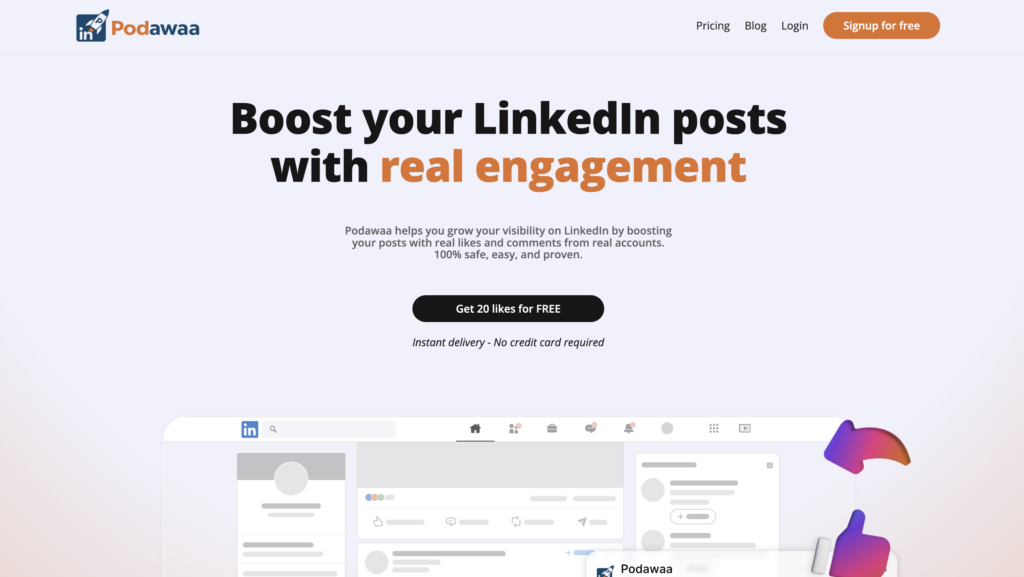
Upside: it can be real if people actually write real comments.
Downside: if it’s mechanical, it gets repetitive fast, and starts to smell scammy. 😬
5) Growth agencies: “LinkedIn visibility”
Some agencies sell packages: strategy + content + engagement + prospecting…
Upside: they can build a real system.
Downside: some quietly slip into fake engagement or borderline tactics. 🫠
How to choose a provider to buy LinkedIn comments?
If you’re at the “I want to test it” stage, at least protect yourself.
✅ Green flags (lower risk):
- Gradual delivery (spread over hours/days).
- Contextual comments (specific references to your post).
- Ability to approve comments before they go live.
- Targeting by language/country/industry.
- Responsive support + clear refund policy.
❌ Red flags (high risk):
- Requests for passwords or direct account access.
- “100% risk-free” promises.
- Comments that are identical or super short.
- LinkedIn commenting on profiles that are empty/inconsistent/new.
- Massive delivery speed (50 comments in 10 minutes).
Examples to assess quality
1. Example of a LinkedIn comment: “good” (useful + conversation)
“I agree with point X. From what I’ve seen, Y works better when you add Z (for example, …). Curious, have you seen the same thing in B2B?”
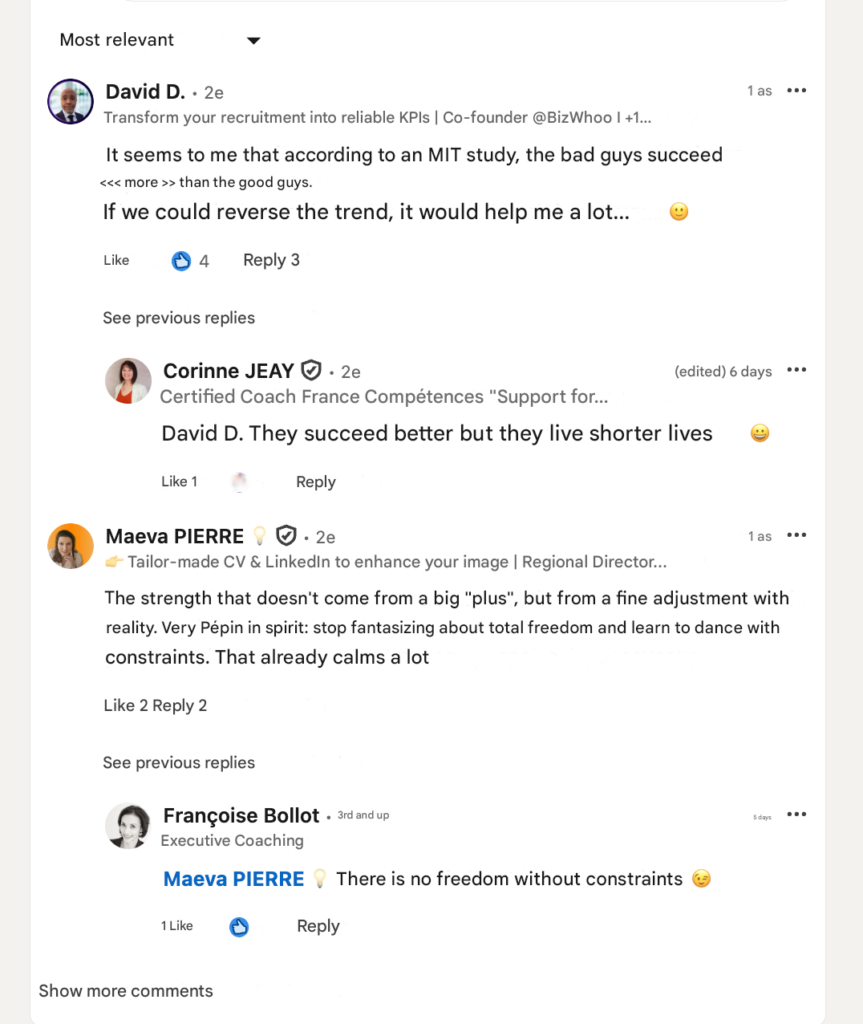
✅ Why it works:
- Nuance.
- Concrete example.
- A targeted open-ended question.
2. Example of a LinkedIn comment: “Average” (nice but weak)
“Thanks for sharing, very interesting!”
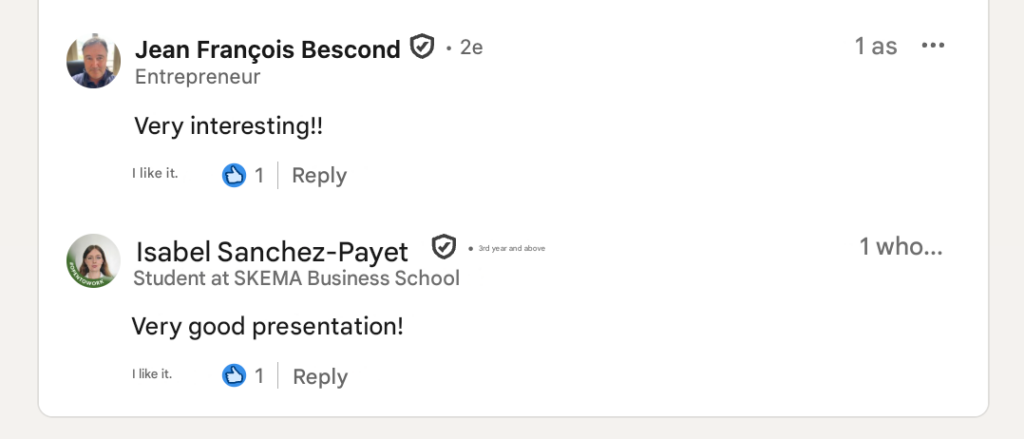
Not harmful… but it doesn’t create conversation. 🤷🏻♀️
3. Example of a suspicious LinkedIn comment (purchased/auto-generated, mediocre quality)
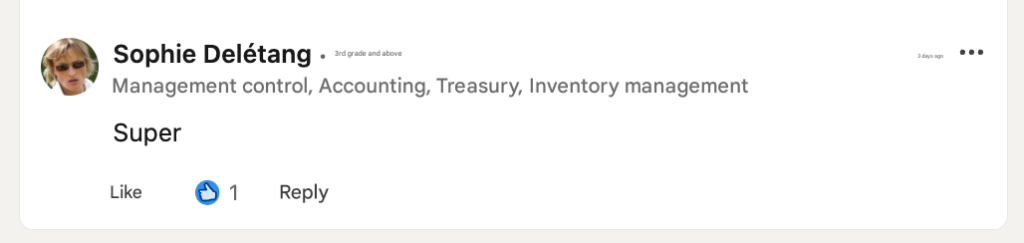
“Great post! So true. Keep up the good work.”
Why it stands out:
- Too generic.
- No reference to the content.
- Often repeated across profiles.
Top 4 legal and effective alternatives to boost engagement (for real)
Good news: you don’t need to buy LinkedIn comments to get results. 👌
1) “Likable comment” structure that gets replies
Use this simple formula:
1) Position (agree or nuance).
2) Social proof (concrete example, mini-story, data).
3) Question (open-ended, targeted, specific).
Template: “I agree with you on ____. I saw it when ____ (example). What would you do if ____?”
2) Bank of 30 LinkedIn comments, ready to adapt
Clarification 👀
1. “When you say ____, do you mean ____ or ____?”
2. “What type of case (team size/sector) are you applying this to?”
3. “What KPI would you use to measure success here?”
Personal experience 🤍
4. “I’ve had the opposite experience with. What changed the game was.”
5. “I tested two approaches: ____ vs. ____. Result: ____.”
6. “Mistake I made early on: ____. ”
Adding value 💎
7. “One step people often skip: __.”
8. “I’d add an example: ____.”
9. “If anyone wants a template/checklist, I can share it. ”
Nuance/debate 🗣️
10. “I agree 80%. The other 20% is ____.”
11. “It depends a lot on ____. What context are you in?”
12. “Counterexample: ____. ”
Story/analogy 🗣️
16. “This reminds me of ____ (analogy).”
17. “Same logic as ____: if ____, then ____.”
18. “People often confuse ____ and ____. ”
Validation ✅
19. “Worth repeating: ____.”
20. “Spot on about ____. ”
Gentle invitation 📨
21. “Curious what __ thinks (light, relevant tag).”
22. “Do you have a concrete example to share?”
23. “If you had to sum it up in one rule: ____? ”
Business opening (without being pushy) 💸
24. “We ran into this at ____: ____.”
25. “This connects to a common problem: ____.”
26. “If anyone wants to go deeper, happy to share more details in DMs. ”
Human and professional 🤝
27. “Thanks for this; it puts into words ____.”
28. “This happens more often than people admit: ____.”
29. “I wish I’d read this two years ago 😅.”
30. “The difference-maker, in my opinion: ____. ”
👉 With this, you can comment on 10 posts/day for 3 weeks without sounding like a broken record.
3) “ Pre-engagement”: the method before publication
Before posting on LinkedIn, DM 5–10 people (customers, partners, colleagues, strong connections):
“I’m posting about ____ tomorrow. What’s your take? Agree/disagree?”
🎯 Goal: get a few real, early, high quality LinkedIn comments, not 30 “Well done.”
4) Responding to comments
LinkedIn algorithm likes conversation, but people like being acknowledged even more (and most creators forget this 🌟).
Simple rule: reply in three lines.
- 1 line of acknowledgment.
- 1 line of clarification/question.
- 1 line of follow-up.
Why do LinkedIn post comments disappear? 🤔 Common reasons:
– The author deleted it.
– The author deleted their account.
– The content got moderated.
– Display bug/latency (it happens).
If you keep seeing “weird” comments vanish… that can also be a quality signal.
How Waalaxy helps leverage this engagement to generate leads
Engagement is the top of the sales funnel. The real question is: what do you do next? 😬
Every interaction is a signal of interest when someone:
- Comments on your post.
- Replies to your comment.
- Visits your LinkedIn profile after an exchange.
…that’s attention you can convert into a real conversation. 💡
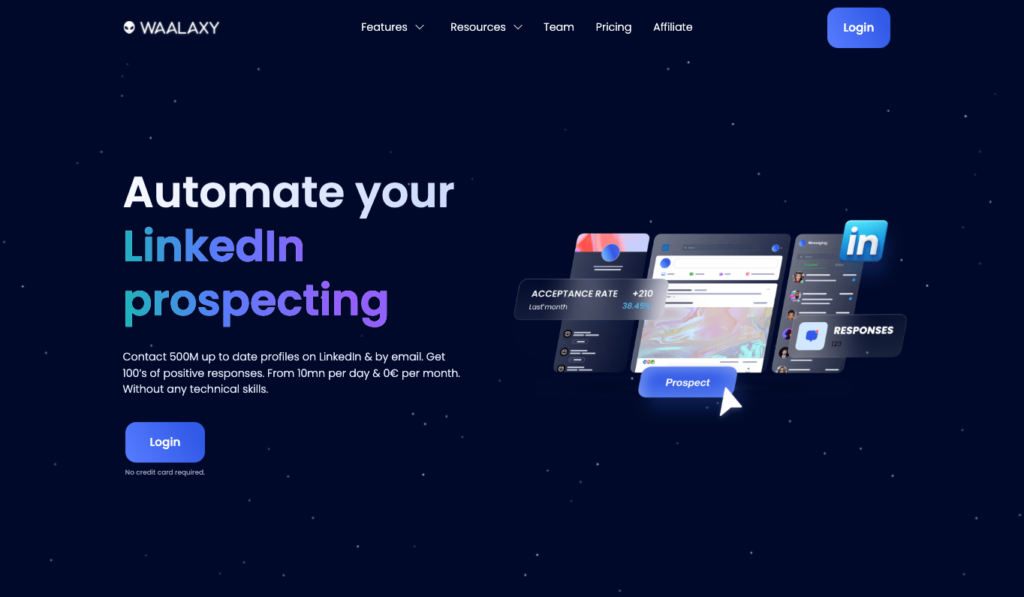
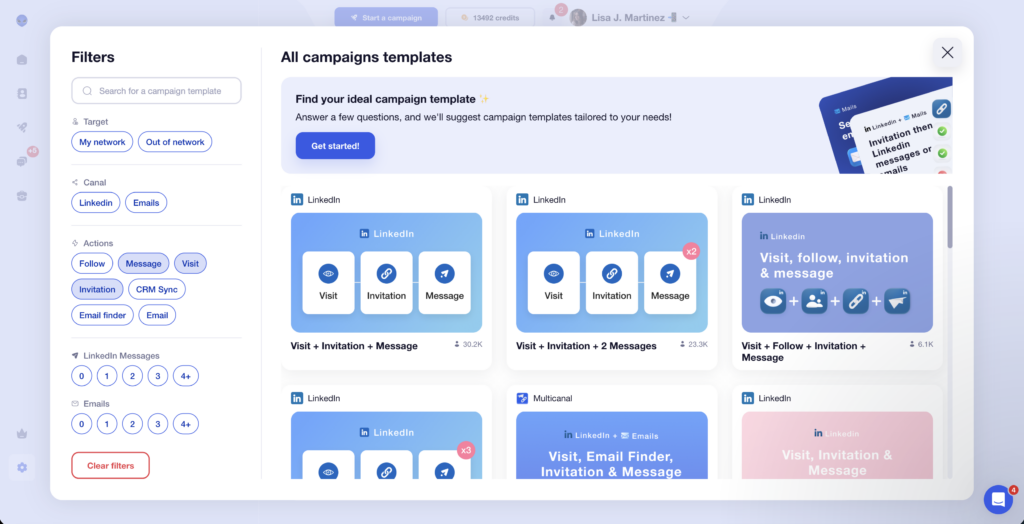
That’s where Waalaxy helps: you build a clean sequence (visit → invite → message) that turns interest into meetings, without spamming.
Mini case study: from comment to appointment
📍 Context: freelance growth/B2B sales.
🎯 Goal: 2 appointments/week via LinkedIn.
Plan (14 days)
- Publish 2 posts (problem + method + example).
- Comment on 10 posts/day in one niche (decision-makers + creators).
- Reply to every comment under your posts (within 24 hours).
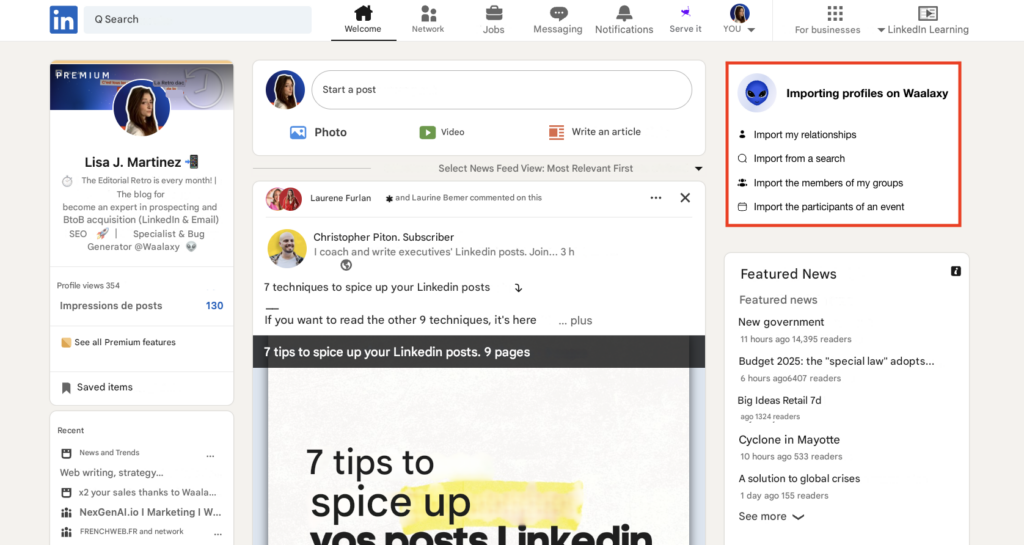
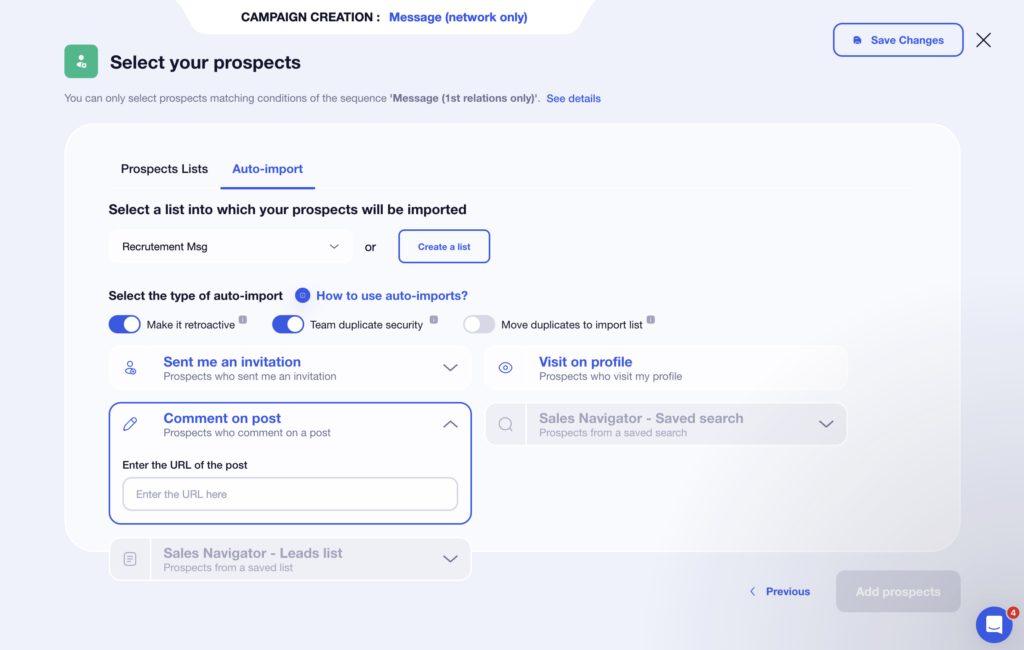
- Identify and interact with hot “profiles” (searches, connections, groups, events, comments, visits, recurring likes, etc.) using Waalaxy auto-import.
5. Launch a Waalaxy sequence 👽:
- Profile visit.
- Short personalized invitation.
- Message 1: contextual question (reference to the post).
- Message 2: useful resource + question.
Realistic observable KPIs
- More profile visits (comment effect)
- Higher acceptance and LinkedIn engagement rates (you’re not “random” anymore)
- More natural replies (not a cold message out of nowhere 🥶).
Key point: you didn’t fake a conversation. You started one, then followed up like a pro.
That’s the opposite of buying comments: instead of paying to simulate a relationship, you build the relationship and then scale your follow-up.
Conclusion: Buy LinkedIn comments is a shortcut… to what?
Buy custom LinkedIn comments can give a post a “fresh coat of paint”… But today, the risk is paying for empty engagement: ❌
- Empty signals,
- Misleading metrics,
- And sometimes a real credibility hit.
What actually works: ✅
- Useful comments (yours).
- Replies (real conversation).
- A conversion system (e.g. Waalaxy).
To sum it up, here is a comparison table of buying vs. alternatives (reach, credibility, risks):
| Option | Effect on reach | Effect on credibility | Risk (reputation/account) | ROI leads |
|---|---|---|---|---|
| Buying comments | Sometimes + in the short term | Often | Medium to high | Low |
| Pods “mechanical” | + short term | Variable | Medium | Medium/low |
| “Quality pods” (small circle) | + | + | Low to medium | Medium |
| Writing assistance AI (Kawaak, etc.) | Indirect + | + | Low | Medium/high |
| Comment routine (10/day) | + strong | + strong | Low | Strong |
| LinkedIn content strategy + network | + strong | + strong | Weak | Strong |
And if you’re short on time or ideas, use LinkedIn AI comments (Kawaak-like), not to fake engagement under your posts. 🤷🏻♀️
Frequently asked questions (FAQ)
🏁 To conclude, here are the answers to the most frequently asked questions about how to buy LinkedIn comments. 👇🏼
Can buying LinkedIn comments help generate real leads?
It can, by accident, if it triggers extra reach and qualified people happen to show up. 🍀 But most of the time you get:
- Unqualified comments.
- Few real conversations.
- Fragile credibility.
If your goal is to generate leads, you’re better off investing in strategic comments and a conversion system.
How can you spot fake or purchased engagement on LinkedIn?
☑️ Quick audit checklist to detect fake comments and fake accounts:
- Generic comments with zero reference to the post.
- Several nearly identical comments across different posts.
-
Profiles with:
- Little real activity.
- Inconsistent LinkedIn network.
- Minimal information.
- A sudden engagement spike followed by a sharp drop.
- No real discussion (no replies, no back-and-forth).
What if I’ve already bought comments, what should I do?
Here’s a simple action plan:
- Stop buying more (don’t amplify the signal).
- Go back to basics: comment, reply, and create real conversation.
- Clean up your strategy: 1 routine + 1 LinkedIn post format + 1 conversion mechanism.
- If the comments are obviously cringe, don’t highlight them; refocus attention on useful content.
We always recommend organic engagement & growth alternatives, but now you know everything you need to know to buy LinkedIn comments! 👌
See you soon! 👽
 Lisa
05/02/2026
Lisa
05/02/2026