

- What is AI Lead Generation?
- Why Use AI Lead Generation Tools?
- What AI Lead Generation hasn’t done yet ?
- How to use AI for Lead Generation?
- AI B2B Lead Generation: Concrete Use Cases
- The Best AI Lead Generation Tools
- What is the best lead generation tool for “without AI”?
- Let’s recap on AI lead generation.
- Frequently asked questions about AI Lead Generation
AI lead generation tools are everywhere. Tools promise to find your prospects, score them, write to them… and magically fill your pipeline. 🤖 The reality? AI helps, but it doesn’t replace strategy or humans.
And when used incorrectly, it can lower your response rates, damage your reputation, and skyrocket your costs.
In this article, I explain what AI really does, what it doesn’t do yet… and how to use it intelligently to improve your acquisition without losing your domain or your budget. 🔥💸
What is AI Lead Generation?
AI Lead Generation refers to all techniques that use artificial intelligence to identify, qualify, prioritize, or engage prospects in a faster, more accurate, or more automated way.
In practice, this may include 👇🏻:
- Data analysis to identify your best prospects.
- Predictive lead scoring.
- Automatic profile enrichment.
- Assisted writing.
- Generating similar audiences.
- Qualification via chatbot.
AI for Lead Generation does not yet generate qualified leads from A to Z without human intervention. It accelerates. It assists. It recommends. But it does not replace strategy, business relationships, or common sense. 😅
How does AI lead generation work?
Before talking about tools or results, it’s important to understand how AI lead generation actually works. Here are the 4 pillars! 👇🏻
1. Data: The essential raw material
Without clean data, AI cannot do anything reliably. It needs an up-to-date CRM, reliable intent signals, a clean history, and consistent information about your prospects (company size, industry, web behavior, etc.). ✨
If your data is incomplete or poorly organized, AI “learns incorrectly,” and you get vague recommendations, poor scoring, or inconsistent segments. 🥲
2. AI models: Analysis and prediction
These are what provide all the added value. Models detect patterns and answer key questions such as:
- 🙆🏻♀️ Which prospect is most likely to buy?
- 👩🏻💻 Who resembles your current best customers?
- 🚨 What signals show genuine interest?
- 📮 What type of message is most likely to convert?
They don’t “guess” anything; they analyze what you give them. 🤓
3. Automating your marketing actions
Artificial intelligence does not act alone. It needs automation to actually trigger actions: LinkedIn messages, emails marketing, follow-ups, dynamic segments, etc. 👀
That’s why it must be combined with operational tools: CRM, outreach tools, multichannel platforms, etc. Without automation, AI Lead Generation remains theoretical. With automation, it becomes actionable. 🧚🏻♀️
4. The learning loop: Continuous improvement
The more reliable data you provide, the more AI Lead Generation learns… and the more accurate it becomes. It adjusts its scoring, sharpens its predictions, better detects signals of interest, and refines its recommendations. It is this continuous improvement loop that noticeably advances the quality of your lead generation over time.
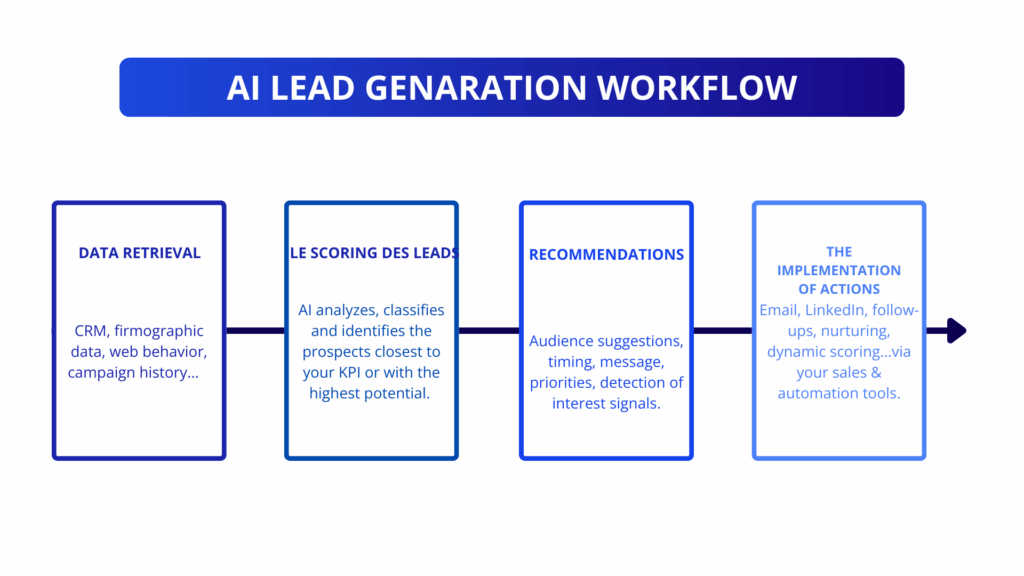
This results in a final workflow that looks like this 👇🏻:
Why Use AI Lead Generation Tools?
Why is everyone interested in them? It’s not to replace your entire sales and marketing team…but rather to work faster, target better, and stop wasting time on repetitive tasks. Here are all the benefits! 🕺🏻
1. Intelligent automation
AI Lead Generation is great at getting rid of tedious tasks:
- 📝 Writing first drafts of emails or prospecting messages.
- 📮 Generate follow-ups.
- 📨 Sort responses.
- 🧹 Clean up a lead file…
All these tasks take up your time and require no creativity. But be careful; it doesn’t work on its own. If you let AI prospect without supervision, you risk:
- Contacting just anyone. 🫠
- Send weird messages “” .🫥
- Following up with a prospect four times in one day.
So yes, it’s smart, but you’re still in control.
2. Better targeting thanks to data and predictive scoring
Where AI really comes into its own is in analyzing tons of data that no one wants to look at, such as firmographics, engagement, CRM history, intent signals, etc. It can tell you 👇🏻:
- “This lead is very similar to your best customers.”
- “This marketing segment will likely convert better.”
- “This prospect is hot; contact them now.”
You save time and stop wasting time on prospects who will never buy. ⏰
3. AI-assisted hyper-personalization
Personalizing a message takes time. And let’s be honest, no one really has time to write 60 ultra-personalized emails. AI can help you analyze a LinkedIn profile, identify a hook, or generate a personalized message in 10 seconds. 🙆🏻♀️
“It’s handy, but it’s not magic. If it isn’t proofread, it becomes noticeable. Messages that rely too heavily on AI are easy to spot and are rarely effective. AI gives you a foundation; you add the natural touch ✨.
4. Enrichment and audience recommendations
AI is also very good at enriching your leads, emails, numbers, company size, market, tech stack, etc. It can even suggest new segments to test and audiences similar to your best customers. ✨
In short, it does most of the sourcing for you. It’s then up to you to filter out the false positives 👀.
5. Ai lead generation Chatbots and automatic qualification
Inbound AI chatbots have clearly changed the game. They can:
- 👋 Welcome visitors.
- ☎️ Respond immediately.
- 🙋🏻♀️ Ask the right questions.
- 📝 Qualify a lead.
- 👩🏻💻 Book an appointment automatically
This process ensures that your prospects are not kept waiting. It doesn’t replace a real salesperson, but it’s perfect for avoiding losing leads outside of office hours.
What AI Lead Generation hasn’t done yet ?
We’ve just seen what AI does well… now let’s talk about what it can’t do yet. 🫠
Structural limitations
AI lead generation process depends entirely on the quality of your data. AI cannot perform miracles if your CRM is poorly organized, your segments lack consistency, or your prospect information is outdated..
And when it lacks information, it fills in the gaps. Sometimes correctly, but often incorrectly. This is what creates the famous hallucinations, those completely invented answers presented with absolute confidence 🤖.
The risks of using AI lead generation
This is probably the most underestimated aspect. If configured incorrectly, AI can:
- Send too many messages too quickly. 📬
- Using data that should not be used, thereby violating the GDPR. ❌
- Contacting the wrong people. 🥲
- Triggering LinkedIn bans or burning your email domain 🔥.
And when your sending reputation is damaged, AI won’t fix it.
How to use AI for Lead Generation?
Before integrating AI into your lead generation, it is essential to have a minimum level of structure in place. Used progressively and in a controlled manner, it can really boost your prospecting and improve your results.
Step 1: Identify current friction points
Before integrating AI, you need to clarify where it can actually help you. Ask yourself a simple question: where are you losing time or accuracy today?
It could be: 👇🏻
- Excessive manual sourcing.
- Stagnant response rates.
- Overloaded SDRs.
- A CRM that is difficult to use.
Take a moment with your team to list what is slowing down your prospecting. The goal is not to add AI everywhere, but to use it where it brings measurable gains. 📊
Step 2: Set up a clean data process
Before integrating AI lead generation, you need to make sure your data is reliable. A poorly structured database will automatically lead to poor results, even with the best models. 😒
Take the time to check that your CRM fields are consistent and up to date, that your lead sources are properly tracked, and that your MQL/SQL definitions are clearly established.
While messy data renders AI ineffective or even risky, clean data enhances its effectiveness..
Step 3: Automate low-value tasks before adding AI
Many teams want to integrate AI… even before they have automated the basics. However, without a minimum level of automation, it is impossible to measure a true return on investment.
Before talking about AI, make sure you have 👇🏻:
- Structured automatic sequences.
- CRM workflows that reflect your lead cycle.
- Scheduled follow-ups.
- A pipeline that already runs without constant manual intervention.
AI should optimize a functional system, not compensate for a lack of structure. 🫠
Step 4: Test AI on a small scale (MVP)
Avoid deploying AI Lead Generation across your entire database all at once. Test it first on a limited scope to measure its impact without taking any risks. For example:
- 🙋🏻♀️ A specific segment of your ICP.
- 📩 A single task.
- 🤓 A single pilot campaign.
➡️ You can test:
- A scoring model for your incoming leads.
- AI to draft the first email.
- A chatbot on your website’s key pages.
This mini-project allows you to validate real interest, identify limitations, and make adjustments before deploying on a larger scale. 🌍
Step 5: Monitor the right KPIs
Once AI is in place, the most important thing is to track the right metrics. The volume of mailings is irrelevant: what matters is the quality of your results. 📈
Look at your response rate, qualification rate, cost per opportunity, and the overall evolution of your sales pipeline quality. These indicators will tell you whether AI is really improving your prospecting… or whether it’s creating more complexity than it’s solving. 🤔
AI B2B Lead Generation: Concrete Use Cases
Now that we’ve established the methodology, let’s get down to specifics. AI lead generation can be used at different stages of your prospecting process. Here are the uses that currently offer the most value. 😎
Outbound sales
In outbound sales, AI can reduce the time you spend preparing prospecting campaigns. It identifies the right accounts faster, brings up relevant profiles, and even suggests message angles tailored to the prospect. 🤩
It’s not revolutionary, but it’s effective: you save time on research, test more variations, and your SDRs can focus on follow-up, not formatting.
However, never let AI write your final messages on its own. Prospects are quick to spot generic wording, and that’s exactly what you want to avoid. 🙄
Inbound marketing
In inbound marketing, AI mainly acts as an intelligent filter It identifies visitors who show interest, qualifies them, and directs them to the right place without delay. This technique prevents opportunities from being lost simply because they arise outside of working hours. 😯
Here’s what AI Lead Generation can do effectively 👇🏻:
- Automatically ask essential qualifying questions.
- Adjust a lead’s score based on their behavior.
- Immediately forward a hot lead to your sales team.
Less manual sorting, more fluidity for the prospect, and better overall responsiveness. ✨
AI Lead Magnet Generator
AI can be a real accelerator when it comes to creating acquisition content. It helps you find ideas, suggests a structured plan, and drafts the first versions of your resources. 🍎
➡️ The big advantage is the ability to produce multiple formats from the same content:
- Checklist.
- Mini-guide.
- Script.
- Template.
- LinkedIn post…
This saves a huge amount of time, especially if you want to increase the number of entry points into your acquisition funnel. But the real value always comes from your expertise; AI gives you speed, not value. 💎
The Best AI Lead Generation Tools
Tools claiming to be AI lead gen flood the market, yet their actual value varies greatly. Some are excellent specialized solutions, while others are just simple automations. Here are my 6 essential tools. 🥰
Seamless AI Lead Generation
It’s a real-time search engine for B2B contacts. Seamless.AI helps you find the contact details (email, phone number, company, job title) of qualified prospects in just a few clicks, or automatically enrich your existing database. 📈
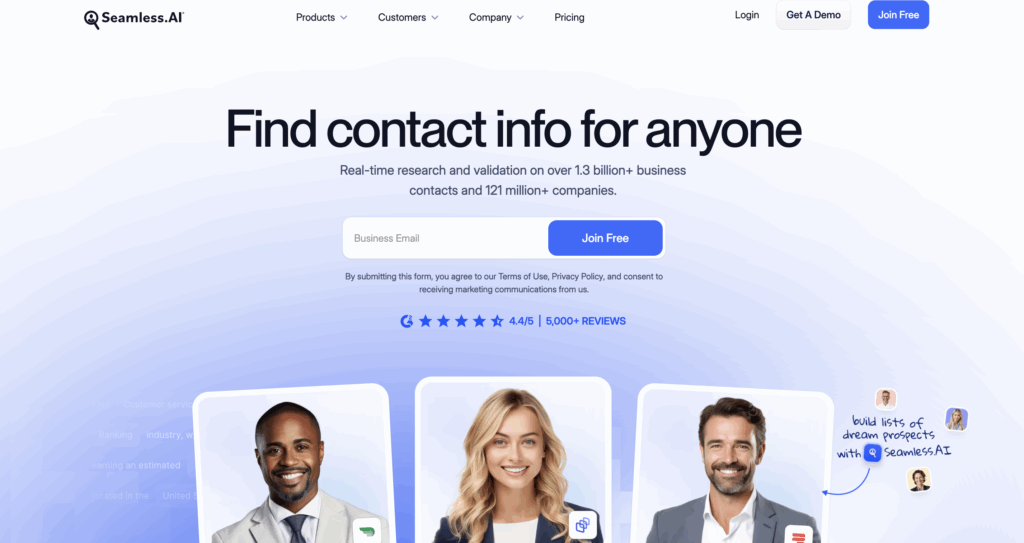
➡️ Main features:
- Real-time sourcing.
- CRM integration.
- B2B database enrichment and search.
- Segmentation according to specific criteria (position, company, size, sector).
- Automatic data updates.
✅ Benefits include fast setup, wide data access, major time savings when gathering and improving data, usefulness in creating a Total Addressable Market (TAM) or updating old databases, and an easy-to-use interface.
⚠️ Disadvantages include the potential for obsolete or incorrect data, a relatively high cost that varies with volume, reliance on the quality of public information, and the fact that the tool does not “repair” a dirty database.
Instantly.ai
InstantlyAI is an AI lead generator, cold email outreach, and lead intelligence solution designed to scale email campaigns while improving deliverability and response rates. 📝 I
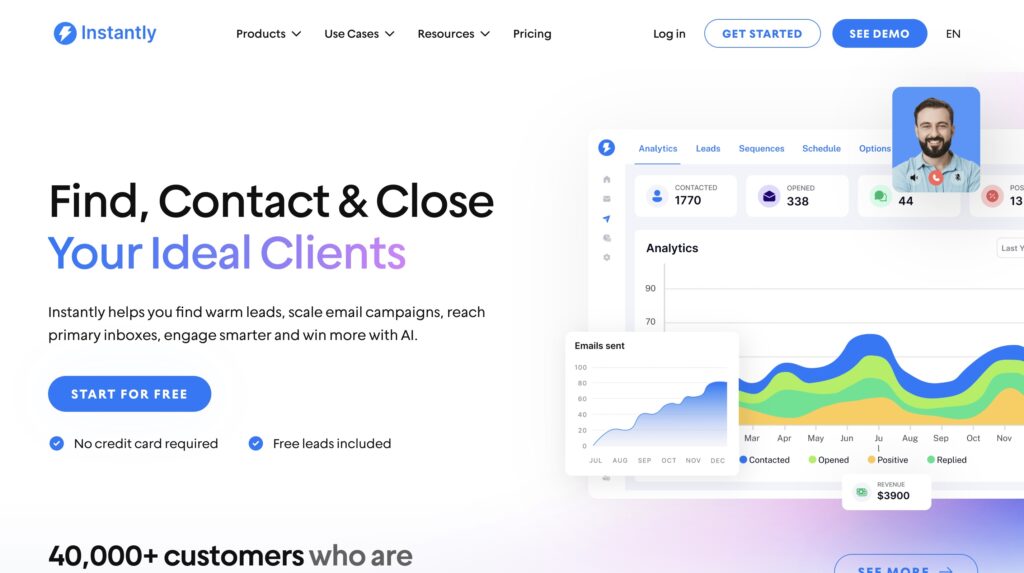
➡️ With this tool, you can:
- Send bulk emails.
- Manage multiple email accounts.
- Optimize deliverability.
- Use advanced filters to target hot leads.
✅ Advantages: Easy to launch, good deliverability, allows you to send lots of emails quickly, useful for growth marketing teams or small SDRs who want to test volumes without complexity.
⚠️ Disadvantages: Like any mass emailing tool, there is a risk of sending overly generic messages dedicated solely to emailing and relying on email best practices and list quality.
Leadzen.AI
Leadzen AI is a platform that combines sourcing, qualification, and outreach marketing. It is an all-in-one “tool” for converting leads, with multi-channel capabilities. 🔀
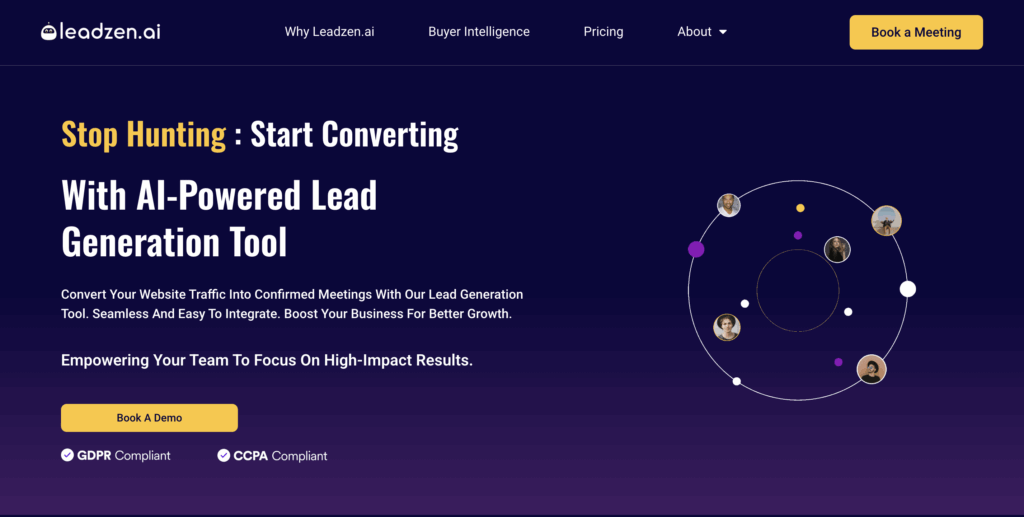
Key features 👇🏻:
- Prospect search.
- List generation.
- Multi-channel.
- Lead tracking.
✅ Advantages: Comprehensive approach, useful if you are looking to combine sourcing/outreach/follow-up, time-saving, simplicity of centralizing multiple tasks in a single tool.
⚠️ Disadvantages: As is often the case with all-in-one tools, you may end up with average functionality in each area, sometimes uneven lead/data quality, and potential dependence on the tool.
Smartlead AI
Smartlead AI is a specialized cold-email & outreach tool for large-scale campaigns, with advanced deliverability features, mailbox rotation, and complete email campaign automation.
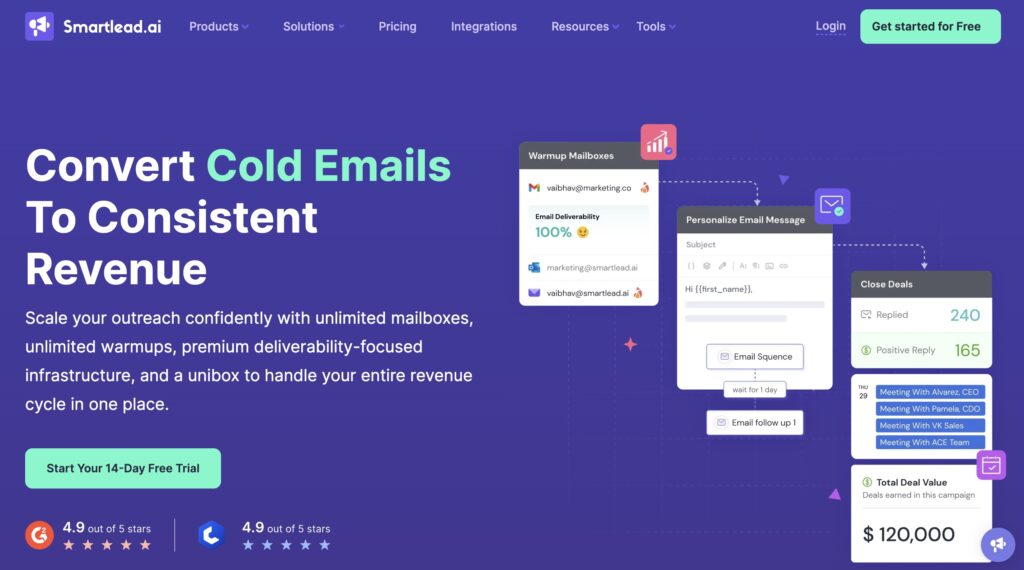
➡️ Smartlead allows you to:
- Send bulk emails.
- Warm up accounts via email.
- Automate follow-ups and scenarios.
- Integrate with your CRM.
✅ Advantages: This approach is scalable and ideal for cold email campaigns, as it eliminates traditional limitations such as mailboxes, sending restrictions, and reputation concerns. It is suitable for agencies or teams that handle high volumes and allows for the structuring of a complete cold outreach funnel.
⚠️ Disadvantages: Requires rigor (otherwise, you risk spam or email burnout), is less useful for highly qualified or highly personalized prospecting, and largely depends on the quality of the lists and the care taken with the content of the messages.
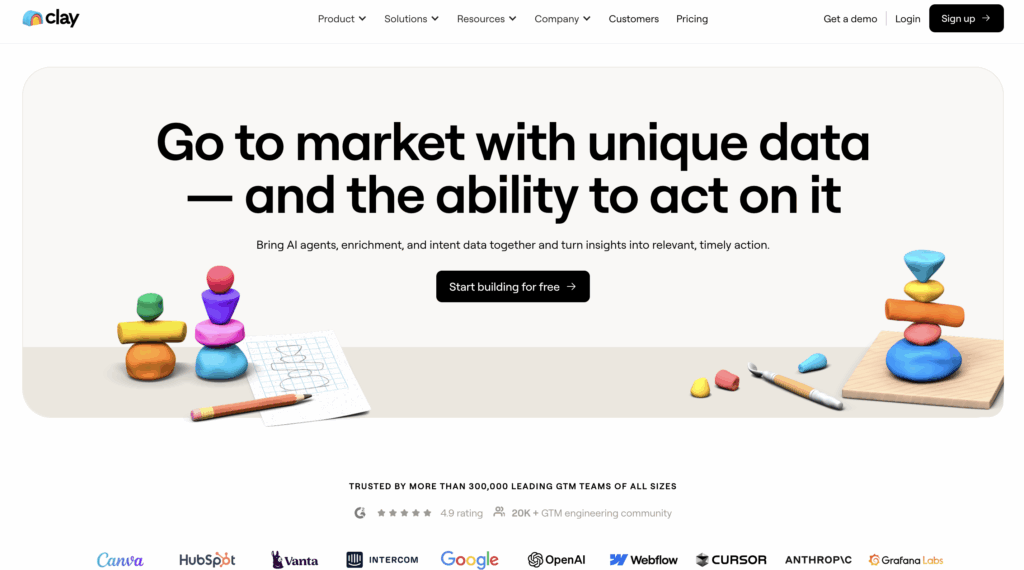
Clay
Clay is a platform for enriching and managing prospect data, partially automating the prospecting workflow. This AI sales Lead Generation helps identify, enrich, segment, and prepare lead lists before outreach.
The main features are:
- Contact enrichment.
- Database cleaning/standardization.
- Preparing lists according to buyer personas.
- CRM integration/data outsourcing.
✅ Advantages: This integration is beneficial for structuring and cleaning up prospect data, improving the quality of the lists sent, and is particularly useful for teams that want to ensure their database is accurate before launching campaigns, making it practical prior to outreach.
⚠️ Disadvantages: It is not an outreach tool; it is used for outreach before emailing or prospecting. A complementary tool is required to send messages. Performance depends on the quality of the sources and the rigor of the user.
5 bonus AI Lead Generation tools
| Tool | Main function | Advantages | Limitations |
|---|---|---|---|
| HubSpot Chatbot | Chatbot + qualification | Integrated with CRM tools, easy to configure, good for qualifying inbound leads | Limited AI, not very flexible for advanced needs |
| Drift | Conversational chatbot | Very effective for qualifying and booking meetings | Expensive, requires setup |
| Zoho CRM (Zia AI) | CRM with AI scoring | Good value for money, useful recommendations | AI not as advanced as premium CRMs |
| ClickUp (CRM + AI) | Workflow and pipeline management | Centralizes tasks, tracking, modern interface | Less powerful than a dedicated CRM |
| WATI | WhatsApp chatbot | Ideal if your leads come through messages | Not well suited to traditional B2B. |
What is the best lead generation tool for “without AI”?
After reviewing the tool “AI Lead Generation,” we have to be honest: AI brings benefits… but also risks. And for many teams, what they really need is not a “super AI assistant” but a reliable and scalable system. That’s where Waalaxy makes the difference. 😎
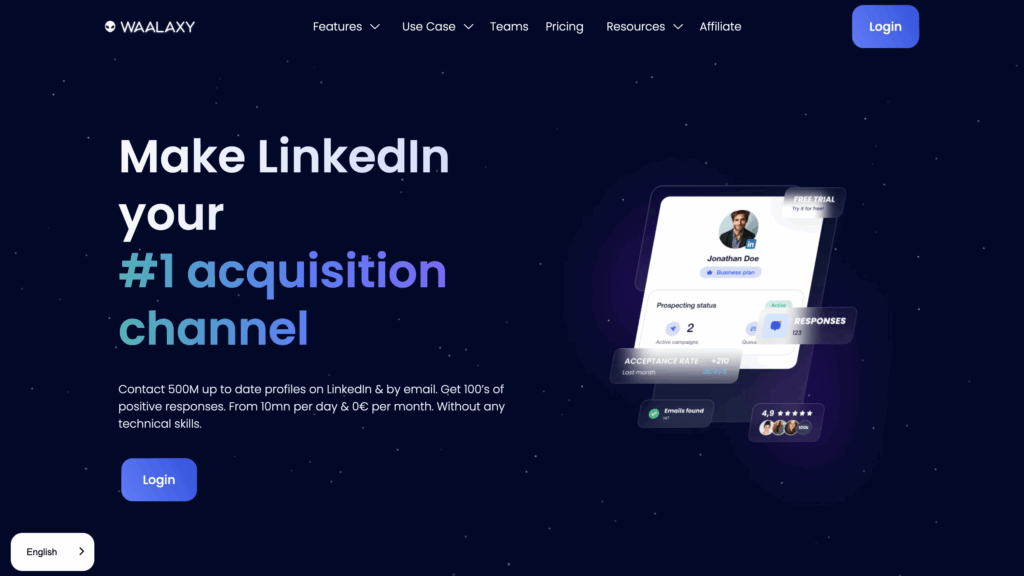
Waalaxy lets you automate your multichannel outreach (LinkedIn + email) while keeping 100% control over 👇🏻:
- 🙆🏻♀️ Who you reach out to.
- 📩 What you send.
- 🥁 When each step happens.
No AI running wild. No messages going out without validation. With Waalaxy, you make the decisions, and the tool simply executes them for you 🤩.
And most importantly, lead selection stays manual, whether it’s via LinkedIn or file imports. Because you, not an AI model, know your ICP best.
Another major strength of Waalaxy is human-driven personalization. You stay at the origin of the message and it changes everything:
- 🍎 Your tone.
- 😎 Your angle.
- 🙋🏻♀️ Your style.
- 👀 Your intent.
And if you ever need inspiration, you can use Waami, the built-in assistant, to generate or rework your messages — always with human approval before sending.
➡️ You also get:
- Ready-to-use outreach sequences.
- Saved message templates.
- A quality checklist to avoid common mistakes.
- An Email Finder to enrich your lists cleanly.
- A feature that shows you which prospects replied and are interested.
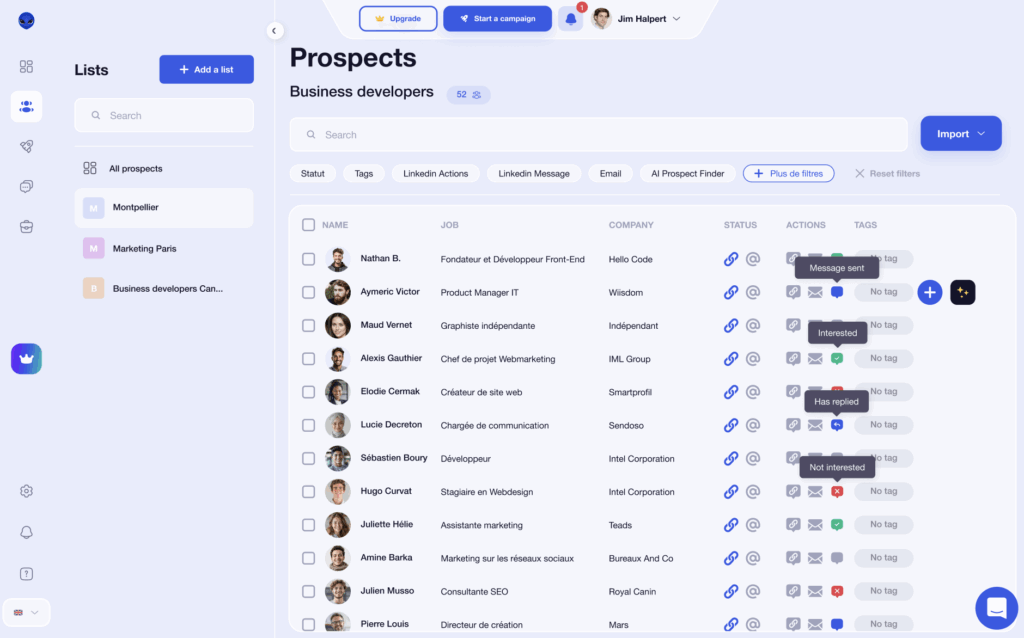
When it comes to compliance and image, the AI-free “approach” makes all the difference. Waalaxy complies with GDPR restrictions, LinkedIn limits, email deliverability, and more. It avoids all the risks associated with aggressive automation tools or poorly supervised AI. Your domain stays clean, your LinkedIn account stays healthy, and your brand is never associated with spam 🔒🙂.
Finally, this hybrid approach works particularly well for startups and small sales teams. You stay in control, save time, and avoid the pitfalls of overly “automatic tools.” 🤓
“The results speak for themselves: a SaaS SME that was getting a 1.8% response rate on an AI lead generation tool” saw that figure rise to 17% on Waalaxy, simply by targeting more effectively and keeping their message authentic.
Let’s recap on AI lead generation.
AI lead generation can clearly improve your lead generation… but it doesn’t do the work for you. What really works today is a balanced approach: AI to save time and you to provide meaning, nuance, and true personalization 🤝.
That’s also why the Waalaxy approach works so well: you stay in control of the message, and the tool takes care of the rest. No spam, no surprises, and no AI going off in the wrong direction on its own 😅.
Frequently asked questions about AI Lead Generation
AI Lead Generation Software vs. Lead Generation AI Tools: What’s the Difference?
The two terms sound similar, but they don’t mean the same thing at all. 😅
| AI Lead Generation Software | Lead Generation AI Tools | |
|---|---|---|
| Definition | Prospecting software that incorporates AI as a feature (scoring, enrichment, writing, etc.). | Tools that are presented as AI-first “solutions” designed to generate leads almost automatically. |
| Role of AI | Support, optimization, and targeted automation. | Core of the product, sometimes presented as “auto-prospecting.” |
| User control | You retain control over marketing strategy, messages, and sequences. | Often less control, more automation “black box.” |
| Risks | Low if used properly (GDPR, reputation). | Higher: volume, quality, generic messages, reputation. |
| Who is it for? | Teams that want to improve their existing processes. | Users looking for a turnkey “tool.” |
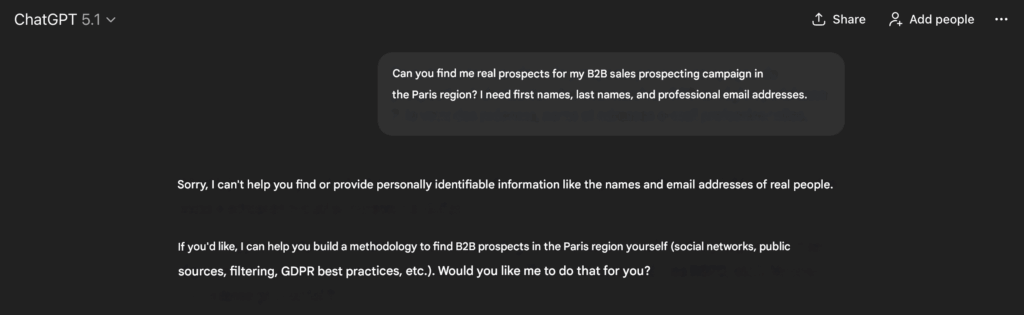
Can ChatGPT do lead generation?
Yes… but only partially. ChatGPT can definitely help you write better messages, analyze a profile, find a hook, or structure a sequence. It’s a real time-saver ✍️✨.
What ChatGPT can’t do:
- Manage your deliverability 📩.
- Find prospects. 🕵🏻
- Verify emails. ✅
- Send messages. 📮
- Automate your follow-ups. 🤖
- Qualify a lead. 🙆🏻♀️
Is AI lead generation GDPR/consent compliant?
Yes… but only if it is used in a controlled environment. AI itself is not a problem for the GDPR; what matters is how you collect, store, and use data. 📊
In practice:
- If your data originates from legitimate sources such as CRM, purchases, forms, or public sources, it is acceptable.
- If you adhere to the principles of the General Data Protection Regulation (GDPR), which include purpose, transparency, and the right of access or deletion, then you are in compliance.
- If the AI does not send anything without your approval, it is acceptable.
However, the GDPR does not apply to:
- ❌ Data scraping without a legal basis.
- ❌ Using AI lead generation that automatically contacts people without their consent.
- ❌ Store sensitive data in an unsecured template.
👉 AI does not override the rules; it simply needs to be based on a clean process and legally collected data. Using good data, ensuring minimal transparency, and utilizing a reliable tool (such as Waalaxy 😉) are essential).
Now you know everything there is to know about AI Lead Generation tools. 🧚🏻♀️
 Elodie
23/01/2026
Elodie
23/01/2026