

Looking to extract information from LinkedIn?
Whether you’re prospecting, recruiting, or analyzing your market, having access to the right data can make a huge difference.
In this guide, we break down how LinkedIn data extraction works, what you can (and can’t) do, and the best tools and methods to get started.
Why Use LinkedIn Data Extraction?
LinkedIn data extraction can significantly improve your prospecting, recruiting, and marketing efforts.
It helps you:
- 🎯Reach the right people (job title, industry, company).
- ⏱️Save time by avoiding manual searches.
- 📈Organize your data in a CRM or tracking tool.
- ⚙️Automate follow-ups and outreach (prospecting campaigns, etc.).
At the end of the day, it allows you to turn LinkedIn into a structured, high-quality database to grow your business.
Pros and Cons of LinkedIn Data Extraction
Before getting started, it’s important to understand both the benefits and the limitations.
| Pros | Cons |
|---|---|
| Significant time savings on lead generation | Data can be incomplete (missing emails or information) |
| Precise targeting of prospects | Restrictions imposed by LinkedIn |
| Improved sales performance | Requires tools for advanced use cases |
| Ability to automate certain actions | Risk of account restrictions if misused |
| Data easily usable in CRM and campaigns | Learning curve for beginners |
What data can you extract from LinkedIn?
Depending on the method you use, you can access different types of data:
- 👤 Personal data: first name, last name, profile photo, location.
- 💼 Professional data: job title, company, industry, experience.
- 📧 Contact information: profile URLs, email (when available), phone number (rare).
- 📊 Activity data: posts, likes, comments, engagement.
- 📄 Profile export: PDF version of a profile (CV format).
This data helps you better understand your prospects, personalize your outreach, and structure your campaigns.
How to Extract Data from LinkedIn Free (All Methods)
Yes there are several ways to download data from LinkedIn, depending on your goals, including secure LinkedIn export methods. 🙂
Some methods are built into LinkedIn, while others require external tools to go further.
Export Your LinkedIn Personal Data
LinkedIn provides a built-in feature to download your personal data.
Go to Settings & Privacy → Data Privacy → Download your data to request a copy.
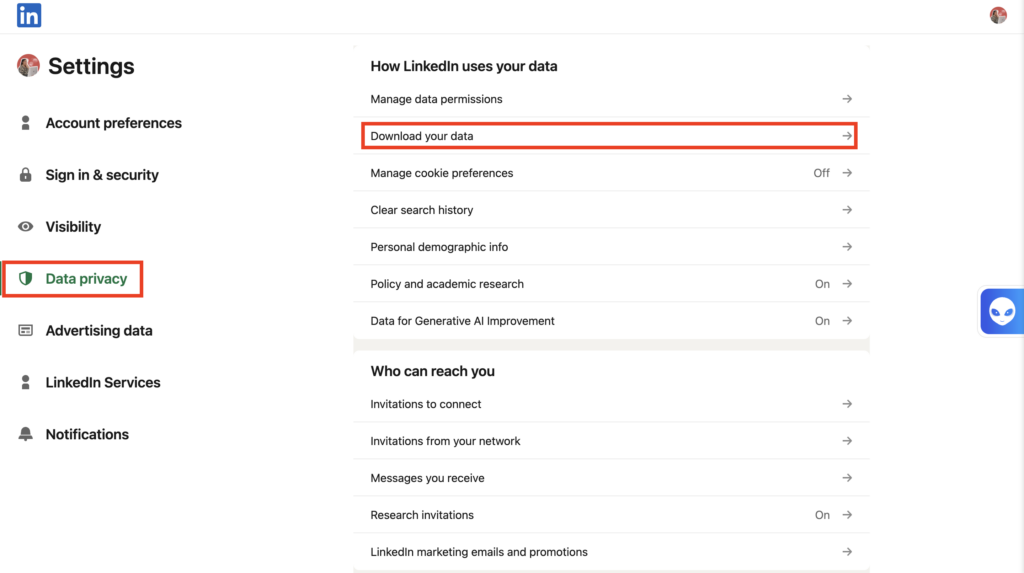
👉 You can choose the data you want to export, including:
- Your articles.
- Your recommendations.
- Your profile data.
LinkedIn also offers a Data Portability API for users in the EU/EEA and Switzerland, allowing them to share their data with third-party apps (with consent).
Export your LinkedIn contacts (CSV)
This is the most common method. You can export your first-degree connections as a CSV file.
Steps:
- Go to Settings & Privacy.
- Click Data Privacy.
- Select Download your data.
- Choose Connections.
⏳ The file is usually available within 24–48 hours.
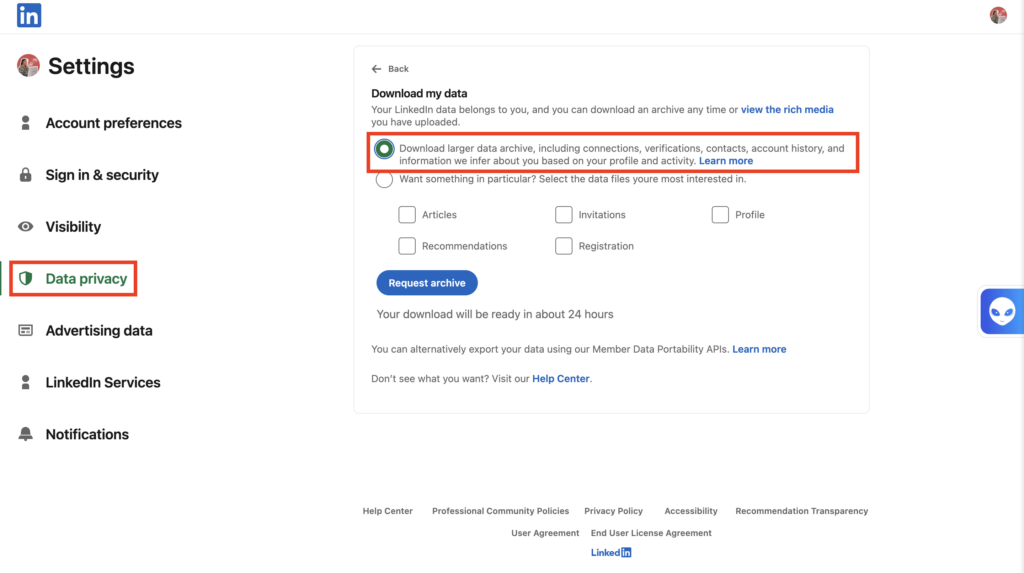
The export includes: First name, last name, Profile URL, Company and job title, Connection date.
Email addresses are only included if your contacts have agreed to share them.
Export Linkedin Search Results
LinkedIn does not allow you to export search results natively (e.g., filtered prospect lists).
To extract this data, you’ll need an external tool.
One workaround is to:
- Send connection requests.
- Add users to your network.
- Export them later via your contacts.
Export LinkedIn Profiles as PDF
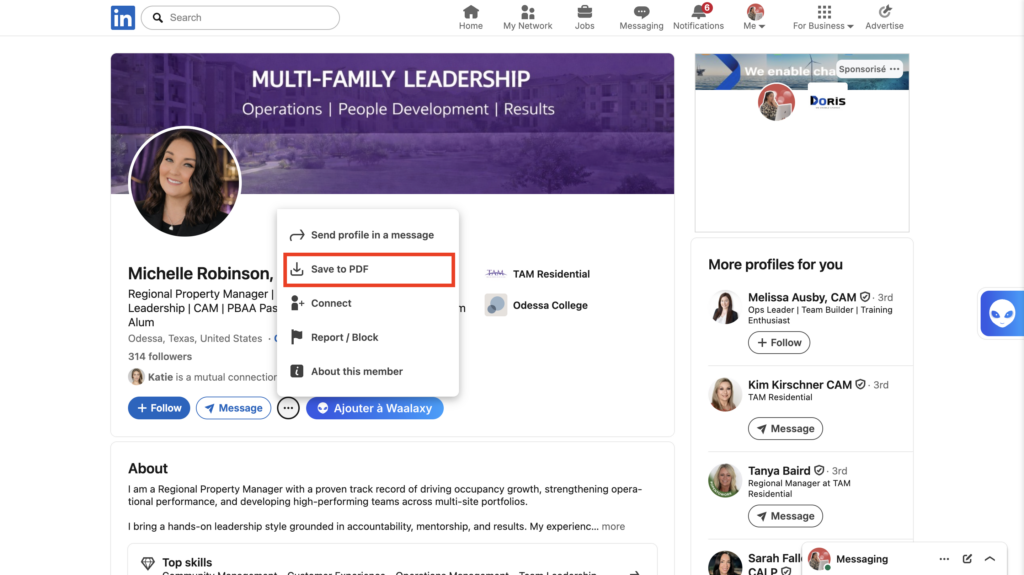
You can easily save a LinkedIn profile as a PDF resume:
- Go to the profile.
- Click More.
- Select Save as PDF.
💡 Useful for recruiters or keeping a clean version of a profile.
Exporting a LinkedIn Sales Navigator Search
LinkedIn does not allow direct export from .
What you can do:
- Create an advanced search (job title, industry, company size, etc.).
- Save the search.
- Add leads to lists.
❌ However, you cannot export this data as a CSV file without external tools.

Specific LinkedIn data extraction use cases
Here are some common use cases where data extraction can be especially useful. 😌
How to export data from LinkedIn Company Pages ?
Extracting data from company pages is useful for B2B prospecting.
You can access:
- Company name.
- Industry.
- Employee list.
However, LinkedIn does not provide a native export option. You’ll need an external tool to structure and use this data.
How to you export LinkedIn Ads data ?
If you’re running LinkedIn Ads, exporting data is straightforward.
You can retrieve:
- Performance metrics (clicks, impressions, conversions).
- Leads (via forms).
- Costs (CPC, CPL, etc.).
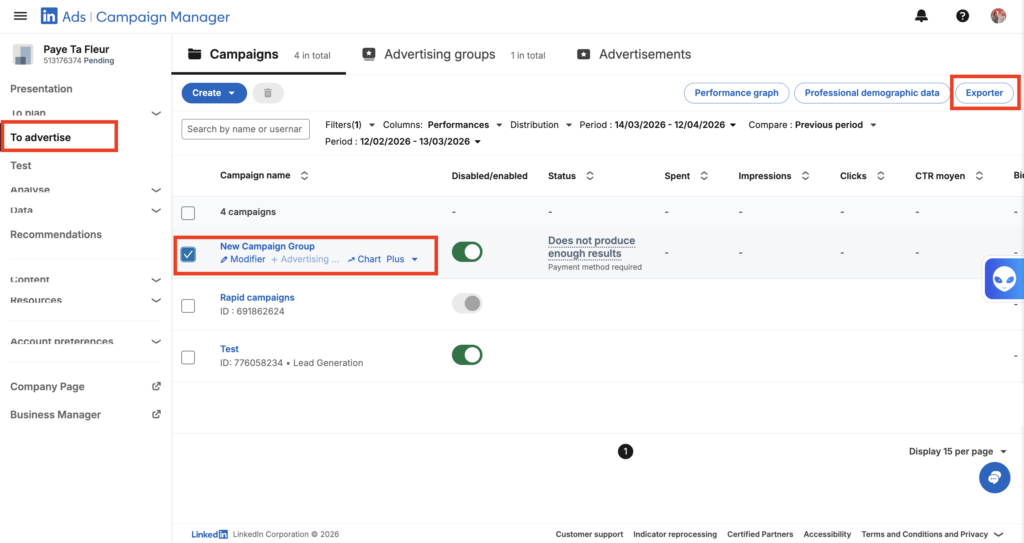
Steps:
- Click Advertise (Run Ads).
- Select your campaign.
- Click Export.
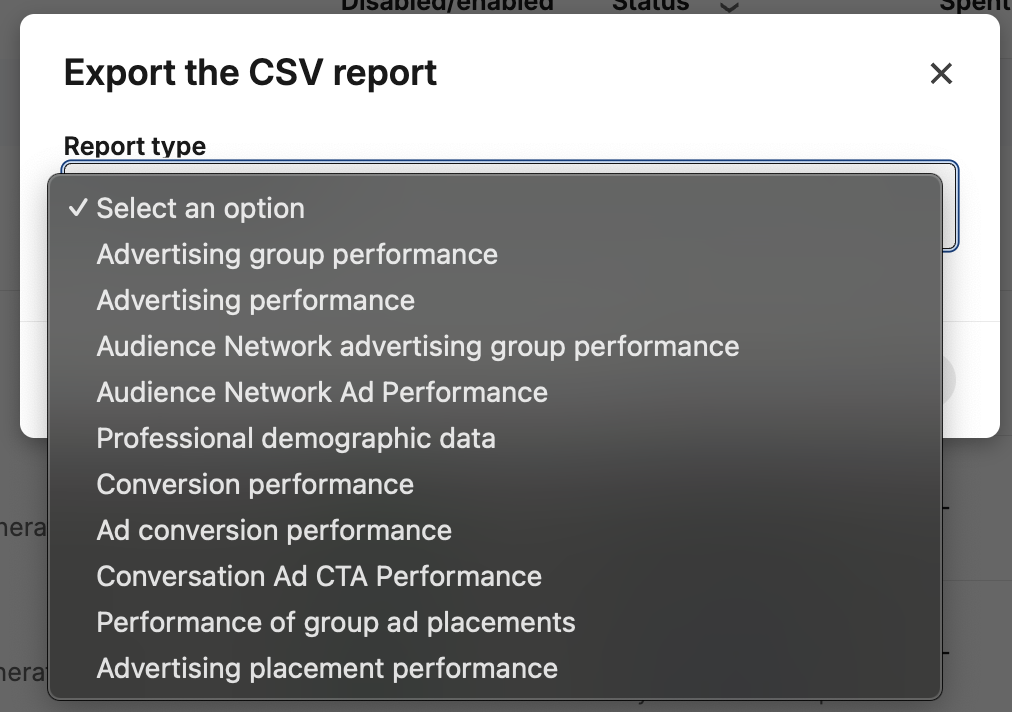
- Select the data type.
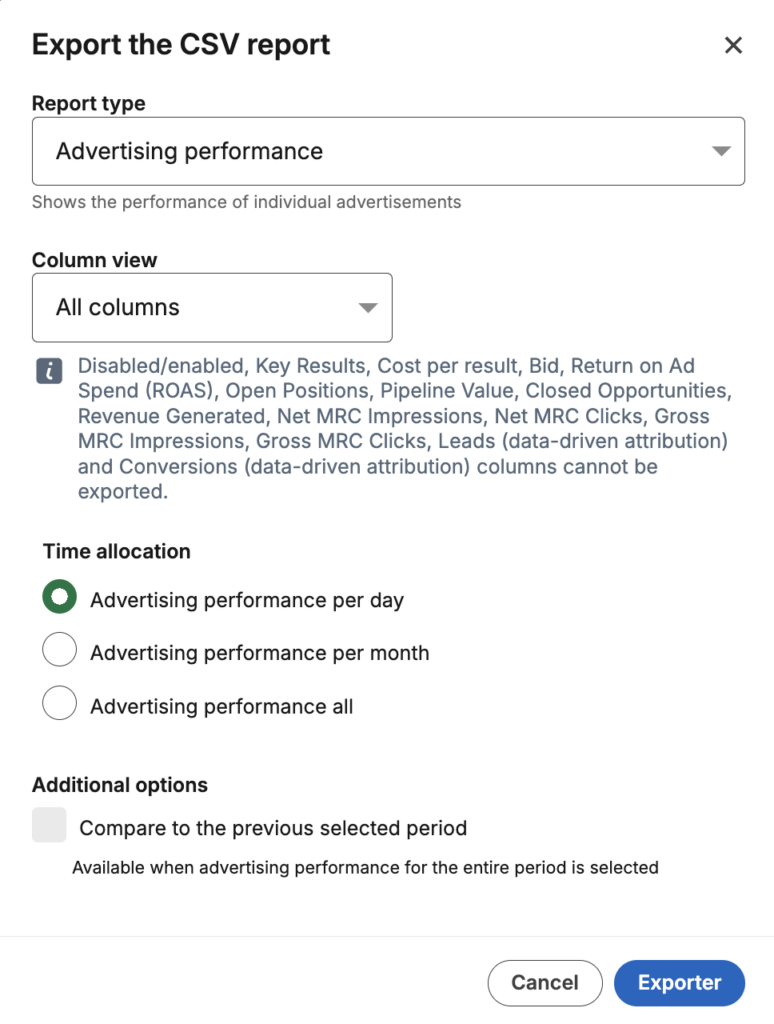
- Set your preferences and download the file.
How to export LinkedIn contacts to a CRM ?
Exporting your LinkedIn contacts to a CRM is essential for effective prospecting.
The simplest method is to export your contacts as a CSV file from LinkedIn and import it into your CRM (HubSpot, Waalaxy, etc.). It works but remains a manual process.
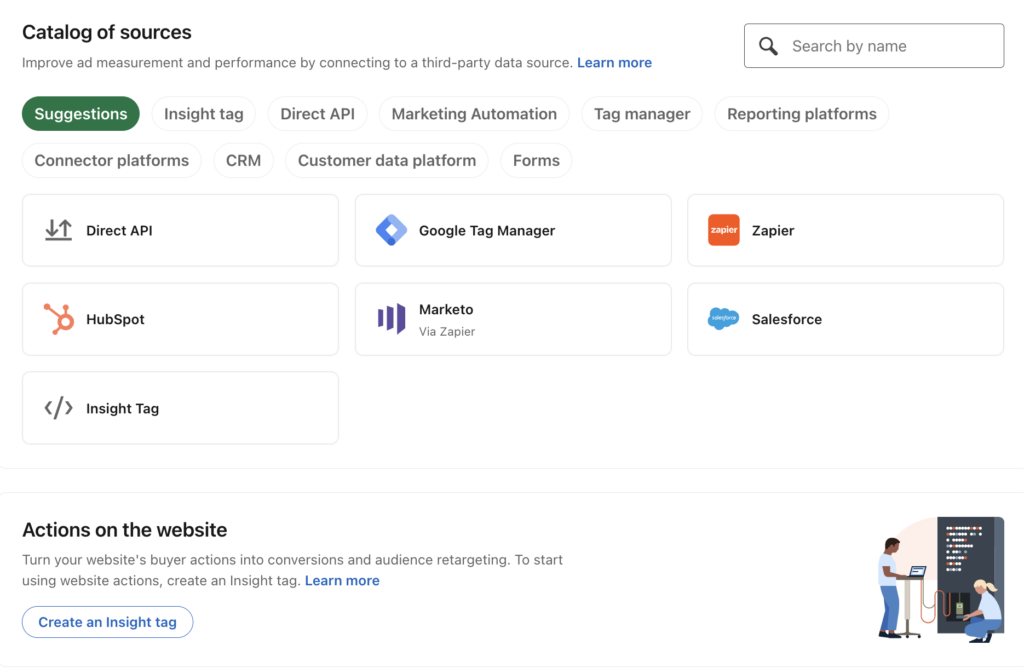
If you use LinkedIn Ads, you can also integrate your campaigns directly with your CRM to sync leads automatically.
What tools can you use to extract data from LinkedIn?
If you want to go beyond LinkedIn’s built-in features, using a dedicated tool quickly becomes essential. 😎
Why use a LinkedIn data extraction tool?
Manual extraction works but it doesn’t scale.
With the right tool, you can:
- Export full prospect searches.
- Target your prospects more precisely.
- Automate outreach actions (connection requests, messages, follow-ups).
📈 As a result, you can manage far more leads without spending hours on manual work.
A simple tool to extract and use LinkedIn data
Among the available solutions, Waalaxy is one of the easiest tools to extract and use LinkedIn data. 🚀
Waalaxy is a Chrome extension designed to automate LinkedIn and email prospecting without requiring technical skills.
It’s built to be simple and efficient, even for beginners. With Waalaxy, you can:
- Import prospect lists via CSV
- Import prospects directly from LinkedIn—even without being connected
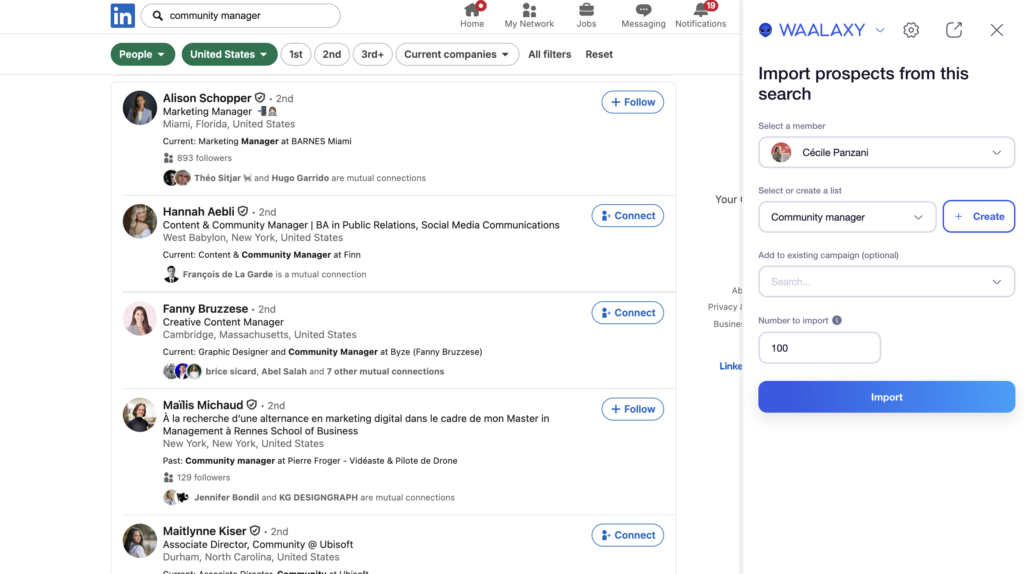
- Segment them based on your criteria.
- Automate your LinkedIn and email campaigns.
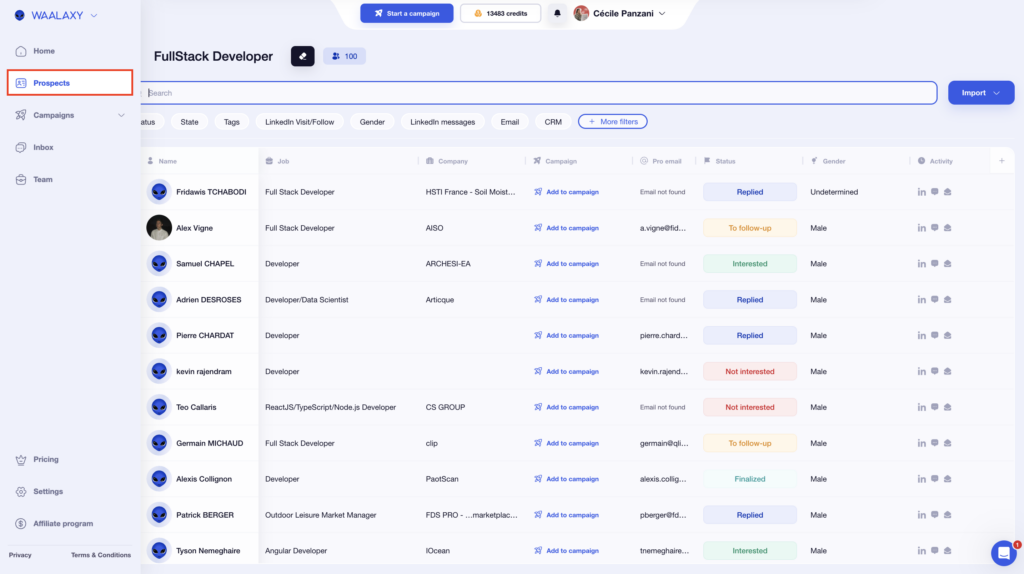
But most importantly, Waalaxy goes beyond standard data extraction. 👀
The tool also allows you to 👇🏻:
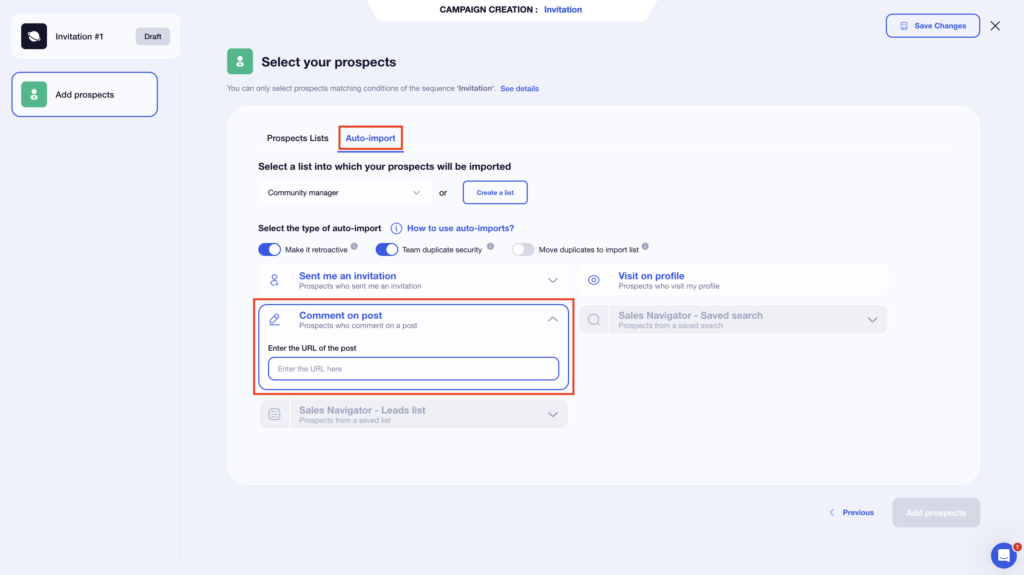
- ⚙️ Automatically capture leads based on their activity (likes, comments, profile data …) with auto-import.
- 📨 Enrich your data with professional email addresses.
- 🔗 Sync your contacts with CRMs and integrations like Make, n8n, or Pipedrive.
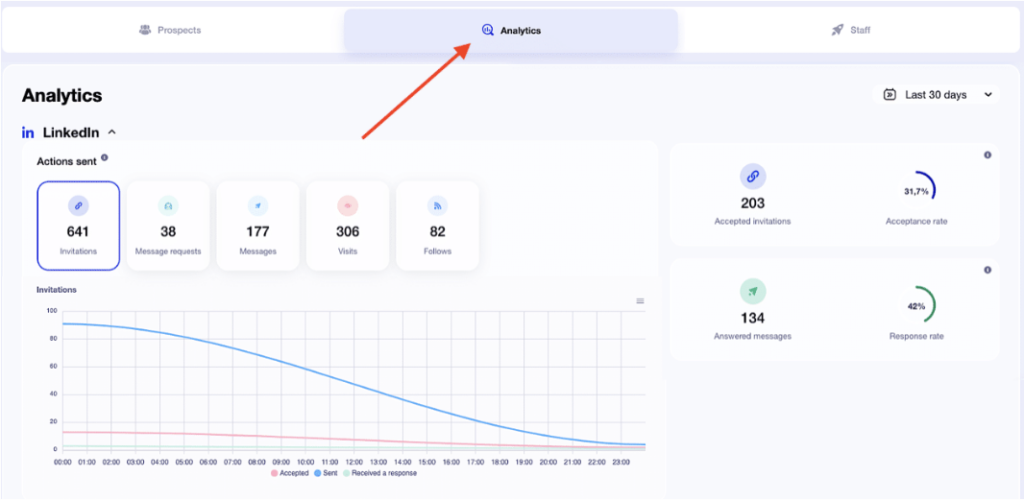
- 📈 Track your performance (response rates, leads generated, conversions).
- 👯♀️ Avoid duplicates with smart database management.
Which Waalaxy KPIs should you track after extracting LinkedIn data?
Once your data has been extracted from LinkedIn, the most important step is to measure its performance. 📊
| KPI | Why it’s important |
|---|---|
| Acceptance Rate | Measures how relevant your is |
| Response rate | Shows how effective your messaging is |
| Number of leads generated | Evaluates the volume of leads obtained |
| Conversion rate | Measures the transition from prospect to customer |
| Follow-up success rate | Helps you optimize your sequences |
Quick recap: LinkedIn data extraction
LinkedIn data extraction is possible but LinkedIn’s native export features are limited.
Between export restrictions, incomplete data, and the lack of automation, you’ll quickly hit a wall if you want to scale your prospecting.
That’s where tools like Waalaxy make a real difference. They help you save time, extract more relevant data, an most importantly turn it into actionable outreach.
FAQ: How to extract data from LinkedIn ?
What tools can you use for LinkedIn data extraction?
There are several tools available depending on your needs, from simple exports to advanced automation.
- Waalaxy → Best for LinkedIn + email prospecting automation
✔ Easy to use, no technical setup
✔ Import prospects from LinkedIn or CSV
✔ Automate outreach and follow-ups
❌ Less flexible than advanced scraping tools - PhantomBuster → Advanced automation & scraping
✔ Very powerful, highly customizable
❌ More complex to configure - Evaboot → Sales Navigator export
✔ Clean and enriched data
❌ Requires Sales Navigator - Lemlist → Multi-channel outreach
✔ Email + LinkedIn campaigns
❌ Not focused on data extraction - Apify → Advanced scraping
✔ Extremely flexible
❌ Requires technical skills - Kaspr → Data enrichment
✔ Fast access to emails and phone numbers
❌ Limited without a paid plan
👉 In short:
- Use Waalaxy for simplicity and execution.
- Use PhantomBuster / Apify for advanced workflows.
Is LinkedIn Data Extraction Legal?
It depends on how you do it.
- ✅ Allowed: exporting your own data via LinkedIn.
- ⚠️ Tolerated (with limits): using automation tools responsibly.
- ❌ Prohibited: large-scale scraping without permission.
If you stay within reasonable usage and follow LinkedIn’s rules, risks remain limited.
How many contacts can you export from LinkedIn?
You can export all your first-degree connections.
Whether you have 500, 1,000, or 5,000 contacts, you can download them as a CSV file.
LinkedIn doesn’t specify a strict export limit, but your network itself is capped at around 30,000 connections.
Can you extract LinkedIn data for free?
Yes but with limitations. LinkedIn allows you to:
- Export your contacts (CSV format).
- Download your personal data.
- Save profiles as PDF.
👉 This works for backups, but not for scalable prospecting.
What’s the difference between LinkedIn export and LinkedIn scraping?
LinkedIn export data and scraping serve different purposes.
LinkedIn export:
- Uses native LinkedIn features
- Fully compliant
- Limited data (contacts, basic info)
- No automation
LinkedIn scraping:
- Uses external tools
- More data (profiles, activity, enrichment)
- Can be automated
- Comes with potential risks
👉 In short:
Scraping = powerful but requires caution.
Export = safe but limited.
Can you export data from LinkedIn to Excel?
Yes but with limitations. You can export your data from LinkedIn as a CSV file, then open it in Microsoft Excel. 📊
That said, this export is manual and limited:
- The data is often incomplete.
- Some details (emails, phone numbers, etc.) aren’t included.
👉 To automate exports to Excel, you’ll need external tools (connectors, scraping, etc.).
⚠️ These solutions aren’t always compliant with LinkedIn’s rules and Data quality can vary.
 Toinon
02/07/2026
Toinon
02/07/2026