

- What is Account-Based Prospecting?
- ABP vs. ABM vs. ABS vs. traditional prospecting: what are the differences?
- Why Is Account Based Prospecting More Effective for Targeting Large Accounts?
- How do you implement an Account-Based Prospecting strategy?
- Which KPIs should you track to measure Account Based Prospecting Success?
- The best sales tools to make your ABP a success
- Let’s recap account based prospecting
- Frequently Asked Questions
Getting leads… but not the right ones? 😅
A pipeline that’s all over the place and key deals that never close?
That’s exactly where Account Based Prospecting (ABP) changes the game.
Instead of chasing volume, you focus on high-potential accounts and put your effort where it actually counts. 🎯
What is Account-Based Prospecting?
Account-Based Prospecting (ABP) is a B2B approach where you target a small number of high-value accounts instead of chasing as many leads as possible.
In practice, you’re not just looking for “contacts”… You target specific companies, identify the right decision-makers, and reach out with highly personalized messages. 🤓
Think of it as the sales-driven version of ABM. Sales teams lead the charge, using channels like LinkedIn and email. 😎
Why Traditional Prospecting Doesn’t Work Anymore ?
Traditional prospecting is all about volume, reach out to as many leads as possible and hope a few convert.
The problem? It’s becoming less effective by the day:
- Decision-makers are flooded with messages (emails, LinkedIn messages, cold calls…). 📩
- Most messages are generic and forgettable.😣
- Sales teams waste time on low-quality leads. ⏳
As a result, the average cold email response rate is just 5.6%.
What are the Advantages of Account-Based Prospecting ?
Account-Based Prospecting flips the script. It’s all about quality over quantity:
- 🎯 Better lead qualification:Target accounts that actually match your ideal customer profile and save time.
- ⭕️ Shorter sales cycles: Personalized, relevant messages grab attention faster.
- 💰 Higher ROI: Less wasted effort, more deals closed, so your prospecting becomes profitable.
- 🧘🏻♀️ Better sales/marketing alignment: Everyone focuses on the same accounts no more friction.
- 📈 A direct impact on the pipeline: You generate fewer opportunities… but they’re far more qualified.
ABP vs. ABM vs. ABS vs. traditional prospecting: what are the differences?
These approaches are often confused… yet they follow very different logics. 🤔
What is the difference between ABS and ABM?
Account Based Marketing (ABM) focuses on targeting strategic accounts through marketing efforts like content, ads, and events.
ABP, on the other hand, is much more sales-driven: 👇🏻
- ABM: Attract and engage target accounts.
- ABP: Direct outbound outreach (LinkedIn, email, etc.).
What is the difference between Account Based Prospecting and Account-Based Selling ?
Account Based Selling (ABS) happens later in the sales cycle:👇🏻
- ABP: Prospecting phase (creating opportunities).
- ABS: Closing phase (turning target accounts into customers).
With ABP, you identify and engage the right accounts.
With ABS, you use a structured sales approach to close the deal.
What is the difference between ABS and Traditional Prospecting ?
Traditional prospecting is simple : more volume means a higher chance of conversion.
ABP takes the opposite approach: 👇🏻
- Traditional prospecting: Generic messages, broad targeting.
- ABP: Personalized messages, highly targeted accounts.
You have fewer contacts but much greater relevance and impact.
Table summarizing all of this 👇🏻:
| Approach | Main Objective | Method | Advantages | Limitations |
|---|---|---|---|---|
| ABP | Generate qualified leads | Targeted outbound prospecting | Fast to implement, high ROI, highly targeted | Requires precision and personalization |
| ABM | Build engagement with key accounts | Targeted marketing (content, ads, events) | Strong brand awareness, long-term nurturing | Slower results, marketing-dependent |
| ABS | Convert accounts into customers | Strategic sales approach | Highly effective for closing big deals | Requires a qualified pipeline |
| Traditional Prospecting | Generate high lead volume | Mass outreach (emails, calls) | Easy to scale | Low conversion rates, poor lead quality |
Why Is Account Based Prospecting More Effective for Targeting Large Accounts?
Traditional prospecting for large accounts just doesn’t work anymore 😅 You reach out to tons of people… and get very little back.
With ABP, you shift your mindset and focus only on accounts with real potential. 🎯
You stop thinking in terms of lead volume and start thinking in account value.
Instead of chasing everyone, you target companies with strong potential, real product fit, and clear pain points. No more wasting time on low-potential opportunities you invest your effort where ROI is highest. 📈
Another key benefit is team alignment and smarter lead routing. With ABP, sales, marketing, and RevOps all work on the same accounts. No more poorly qualified or ignored leads. Everyone moves in the same direction—better coordination, stronger messaging, and cleaner CRM follow-up. 👀
Most importantly, the impact on performance is immediate. When you target better and personalize your outreach, results follow:
- 📩 More responses from decision-makers.
- 🤝 More qualified meetings.
- 📈 More real opportunities in your pipeline.
- 💰 More deals closed, often bigger ones.
How do you implement an Account-Based Prospecting strategy?
Effective ABP is built on four key pillars 🗼:
- The right account.
- The right timing.
- The right message.
- Consistent follow-up.
Here’s how to do it in just 7 simple steps!
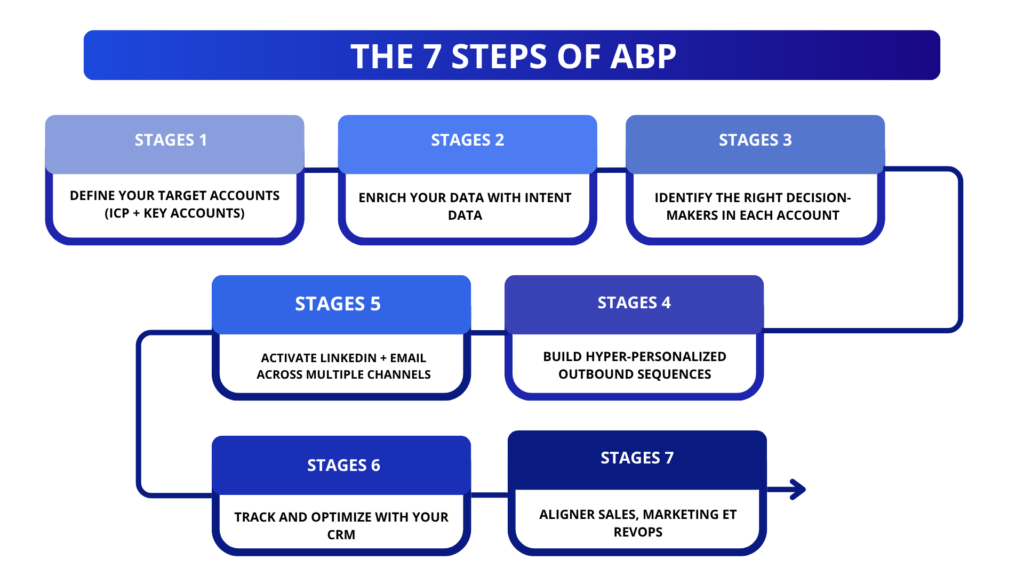
Step 1: Define your target accounts (ICP + key accounts)
Start by looking at what’s already working for you. Identify your best customers (top 20%), the ones who close quickly, stick around, and generate the most value. 💎
Don’t overcomplicate it, just figure out what they have in common. In most cases, you’ll see patterns like:
- A specific industry (e.g., B2B SaaS).
- A similar company size (e.g., 50 to 500 employees).
- A similar level of maturity (startup, scale-up…).
- A clear problem your product solves.
To find this information, start with your own data. Your CRM is a goldmine—whether you use HubSpot or Salesforce. Then enrich it with external data (like Crunchbase) to better understand company growth, funding, and maturity. 🕵🏻♀️
By the end, you should have a list of 100 to 500 accounts that look just like your best customers your high-ticket sales. Not a huge list. Not a vague one. A focused, actionable list.
If you’re hesitating between segments, go with the ones that are easiest and fastest to close.
Step 2: Enrich your data with intent data
Once your accounts are defined, timing becomes key. Not every account is at the same stage some are just discovering you, others are actively looking for a solution. 🕵🏻♀️
Here are the key signals to watch:
- Visits to high-intent pages (product, pricing, etc.). 💸
- Engagement with content related to your solution. 📲
- Searches tied to the problems you solve. 🔎
This intent data show a specific need is emerging. Ultimately, you need to be able to prioritize your accounts based on their level of interest: cold, lukewarm, or hot.🔥
Step 3: Identify the right decision-makers in each account
Once your accounts are prioritized, identify who actually drives the decision. In B2B, decisions are rarely made by just one person. Aim for 5 to 10 contacts per account across different roles. 👩🏻💻
80% of B2B decisions involve multiple stakeholders.
The profiles to target are generally 👇🏻:
- A decision-maker (CEO, VP, director…).
- A user or operator (Head of Sales, etc.).
- An internal influencer (Ops, IT, Finance, etc.).
Never rely on just one contact. Create multiple entry points within each account. In every account, aim to connect with a leader, an executive, and an ops profile. 👩🏻🔧
Step 4: Build hyper-personalized outbound sequences
At this stage, everything comes down to your message. No need to overcomplicate it but it has to be relevant. 🤓
The goal is to quickly show you understand their context. A quick detail about the company, a recent update, a key change, that’s enough to grab attention. 👀
Then, focus on a specific, relevant topic. Something they’ll instantly recognize. Next, introduce your value proposition, simply and clearly. No hard pitch just what you help improve. 😉
And you wrap up with a real call-to-action. 🤝
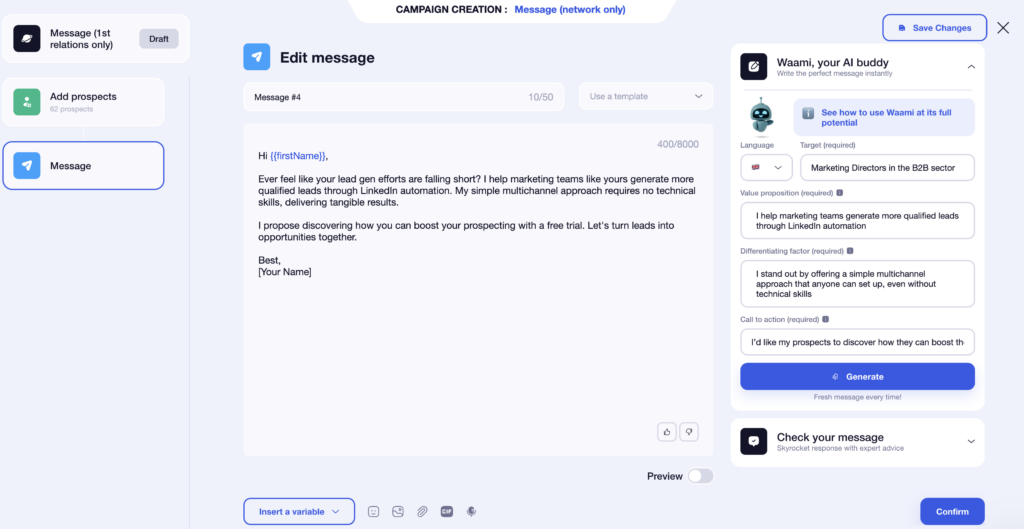
The message to copy/paste:
Hi {{firstName}},
I came across your website and noticed you’ve been investing more in inbound lately.
From experience, that’s usually where teams start generating more leads… but not always more closed deals.
That’s actually where we come in we help teams better qualify and convert their existing leads, without needing to increase volume.
Would you be open to a quick 15-minute chat sometime this week or next?
If so, here’s my Calendly link:
[Calendly link]
Step 5: Use LinkedIn + email as a multi-channel approach
Today, one message just isn’t enough. Your prospects are constantly bombarded with messages, so if you only show up once… you’ll be forgotten. 🥲
The goal is to show up in multiple places without being pushy. Combine two powerful channels: email and LinkedIn.
A single message might be ignored, but several consistent interactions build familiarity. A profile visit, a message, an email, a comment… little by little, you become recognizable. 👀
On average, it takes 7 to 12 touchpoints to get a response.
What matters most isn’t quantity, but consistency. Spread your outreach over several days, using simple, aligned . 🕺🏻
In the end, your prospect no longer just sees your name they recognize it. And that changes everything in their response! ✨
Step 6: Track and optimize with your CRM
Once your campaigns are live, the real work begins. Without follow-up, you won’t know what’s working and you’ll miss opportunities. 😔
Your CRM tool becomes your command center. This is where you track everything, responses, meetings, and pipeline. No matter the tool, the goal is simple : full visibility into performance. 📊
What matters most? Reviewing it regularly:
- Which messages perform best?
- Which accounts are engaging?
- Where are the bottlenecks in your sales funnel?
Then iterate, step by step. Refine your messaging, targeting, and timing. That’s when performance starts to scale. ✈️
Look at results by account not just by contact. If 3 out of 5 people in the same company respond, that’s already a win. 🥇
Step 7: Align Sales, Marketing, and RevOps
An account based prospecting strategy won’t work if sales and marketing teams operate in silos… Sales-marketing alignment isn’t just theory it has to be built. 🏠
- Start by defining a single list of priority accounts, shared by everyone.
- Then set up a quick weekly check-in (30 minutes is enough). The goal isn’t another meeting—it’s answering three simple questions:
- Which accounts are progressing?
- Which ones are stalled?
- Where are the opportunities to pursue?
Sales: Bring field insights, feedback, objections, early signals
Marketing: Adapt with strong content, messaging, and campaigns
RevOps: Ensure clean data, clear tracking, and an up-to-date pipeline
Over time, everyone works the same accounts with shared data and goals. This boosts alignment, motivation, and true team ownership. 😇
Account Based Prospecting works very well… but only if you’re willing to do less, but do it better. 😎
Real-world example: B2B SaaS case study
Let’s take a B2B SaaS company that sells a solution to sales teams.
Before, the team was doing traditional prospecting, with lots of emails sent, little personalization and fairly broad targeting. The result 😅 low response rates, an unstable pipeline and long
So they decide to apply an Account-Based Prospecting strategy by following the 7 steps. 🤓
They start by defining 40 strategic accounts based on their best customers. Then, they enrich their list with intent signals to prioritize the most active accounts.
They identify multiple decision-makers per company to avoid relying on a single contact. Then, they build personalized messages based on the real context of each account.
On the execution side, they activate a multichannel approach with LinkedIn and email, multiplying touchpoints progressively. Everything is tracked in their CRM to analyze performance and continuously adjust. ⭕️
Finally, they align sales, marketing and RevOps around the same account list. 👯♀️
After 3 months, the results are clear: 📈
- 📩 Response rate multiplied by 2.
- 🤝 More qualified meetings.
- 📈 A more stable pipeline.
- 💰 15% increase in closing rate.
They generate fewer opportunities, but much more relevant ones, simply by applying the right ABP fundamentals. 😌
Which KPIs should you track to measure Account Based Prospecting Success?
A few key metrics are all you need to know if your strategy is working or wasting your time. 🫠
Prospecting Key Metrics
These metrics show whether your outbound efforts are actually working:
- Response rate.
- Appointment rate.
- Number of engaged accounts.
- Number of contacts reached per account.
If these numbers are low, the issue is usually your targeting or your messaging. 📨
Business KPIs
This is where you measure real revenue impact 👇🏻:
- Pipeline generated per account.
- Opportunity conversion rate.
- rate.
- Average deal size.
- Revenue generated.
This is what tells you if your account-based prospecting is actually profitable. 💸
How do you calculate the ROI of an Account Based Prospecting strategy?
The formula is simple 👇🏻:
ROI = (revenue – cost ) / cost
➡️ To clarify:
- Revenue: This is all the revenue directly linked to your account based prospecting efforts.
- Cost : This is everything you invest to run your ABP (marketing tools, salaries, ads, time spent, service providers, etc.)
- Revenue generated – Cost: This is your actual profit.
- Divided by the cost: This is what allows you to measure how much you earn for every euro invested.
Example:
You generate $100,000 in revenue with your ABP.
You’ve invested $20,000.
ROI = (100,000 – 20,000) / 20,000 = 4. 👉 That’s a 400% ROI.
The best sales tools to make your ABP a success
Here are the three essential building blocks to structure your strategy and choose the right account-based prospecting platform. 🕺🏻
| Category | Role | Examples of tools |
|---|---|---|
| Data & Intent Tools | Enrich your accounts and detect buying signals | 6sense, Bombora, Clearbit |
| CRM & Pipeline Management | Track your leads, opportunities, and revenue | HubSpot, Salesforce |
| Tracking & analytics tools | Measure performance and optimize your actions | Google Analytics, Hotjar |
Can Account Based Prospecting be automated? (LinkedIn + email)
But wasn’t there a step missing? 👀
Once your strategy is set, your accounts are targeted, and your messages are ready, you need to keep the momentum without spending all day on it. 😮💨
That’s exactly where tools like Waalaxy come in.
In practical terms, they let you send your sequences on LinkedIn and via email, automate follow-ups, and maintain a consistent presence with your prospects without doing everything manually. ✍🏻
➡️ In B2B, this means you can:
- Follow up on touchpoints without forgetting to reach out again. 📩
- Centralize all your conversations in one place with the Inbox. 📬
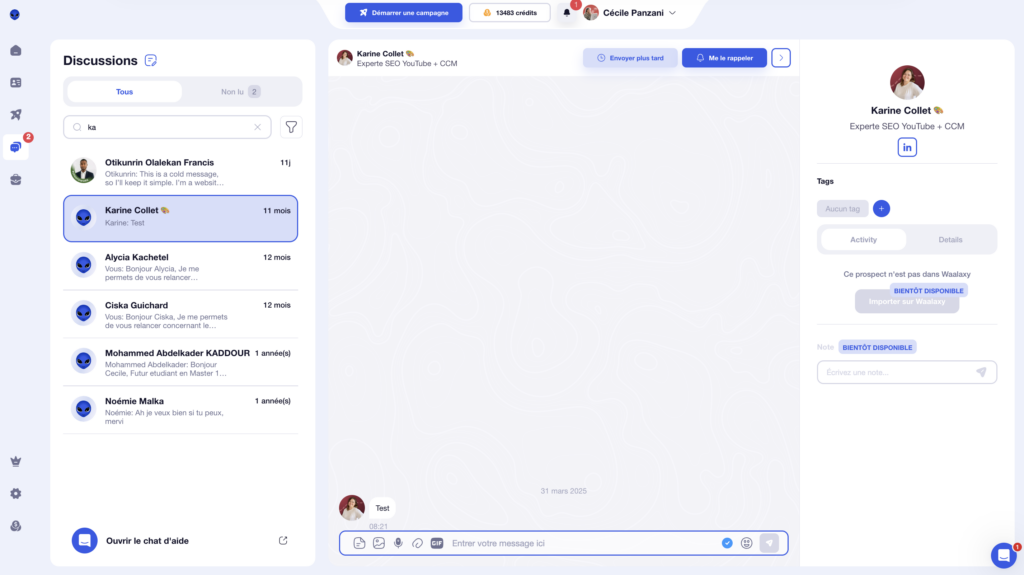
- Prioritize the most engaged prospects. 🥇
- Maintain consistency in your LinkedIn prospecting. 📨
- Connect your tools like HubSpot or Make, which keeps your workflow running smoothly. 🔗
Let’s recap account based prospecting
Account Based Prospecting isn’t just another technique.
It’s a shift in mindset and a true sales enablement lever. 👀
You stop chasing leads… and focus on lead qualification and the right accounts, at the right time, with the right message often supported by B2B account targeting tools. If you apply even just 3 of these steps, you’ll already see the difference. 🥳
Less volume, more precision.
Less noise, more impact.
And that’s what sets top-performing teams apart today.
Frequently Asked Questions
What mistakes should you avoid in Account Based Prospecting?
Mistakes in ABP are often simple… but costly if left uncorrected:
- Moving too fast without clear targeting or .
- Sending generic messages (instant “spam” effect).
- Relying on a single contact within an account.
- Not tracking or analyzing performance
ABP requires discipline without targeting, personalization, and management… results won’t follow. 😣
Does Account Based Prospecting work for SMEs?
Yes, and often very well.🤩
ABP isn’t just for large companies. On the contrary, it’s particularly well-suited for SMEs that need to be precise in their key account prospecting rather than focusing on volume.🥹
With a small team, intelligently targeting 50 to 200 accounts can generate far better results than hundreds of poorly qualified leads.
How many accounts should you target?
Too many accounts, and you lose personalization. Too few, and you miss opportunities. 😅
In most cases, a base of between 100 and 300 accounts is a good balance to start with. What matters isn’t the number… it’s your ability to execute your activation effectively. 🙃
What’s the difference between ABP and social selling?
Account based prospecting is a comprehensive strategy. You target specific accounts and deploy several coordinated actions (email, content, ads, outbound outreach, etc.).👩🏻💻
Social selling, on the other hand, is a channel. It involves using platforms like LinkedIn to build relationships and engage prospects. 🤳🏻
How do you prospect for large accounts?
Prospecting large accounts isn’t about volume, it’s about precision. That’s exactly what Account-Based Prospecting (ABP) enables.
Instead of contacting everyone, focus only on companies with real potential. 🎯
Then take time to understand each account, its challenges, context, and priorities. That’s what makes your messaging relevant.. Here are the fundamentals… which form the foundation of ABP:👇
- Target a small number of highly qualified accounts.
- Understand their challenges.
- Reach out to multiple decision-makers.
- Personalize each message.
- Activate multiple marketing channels.
Finally, follow up consistently. It’s often the repetition of touchpoints that triggers responses. 👀
Now you know everything about Account Based Prospecting. 🧚🏻♀️
 Elodie
22/06/2026
Elodie
22/06/2026