

- How to structure a LinkedIn prospecting message
- The 5 golden rules for writing LinkedIn prospecting messages
- How to write a successful LinkedIn follow-up message
- 13 LinkedIn prospecting message templates
- Which Waalaxy campaign should you use for LinkedIn prospecting?
- Quick recap
- FAQs About LinkedIn Prospecting Messages
Have you ever wondered why some LinkedIn prospecting messages get ignored while others instantly spark conversations? 👀
The secret to successful prospecting is simple: sending the right message to the right person at the right time.
The problem? Most prospecting messages still sound generic, overly salesy, or completely irrelevant. 🤔
And that’s a huge mistake, because your first message often determines whether a prospect replies… or ignores you forever.
A strong LinkedIn prospecting message can help you:
- grab attention,
- start meaningful conversations,
- and generate more qualified leads.
So, if you want to stand out from the flood of copy-paste outreach messages, you’re in the right place. In this guide, you’ll discover:
- best practices for LinkedIn prospecting,
- common mistakes to avoid,
- and 13 ready-to-use prospecting message templates you can copy, personalize, and send today. 🔄
No complicated jargon. No endless theory. Just practical, effective LinkedIn prospecting messages designed to get more replies. 🚀
How to structure a LinkedIn prospecting message
The structure of your LinkedIn prospecting messages breaks down into three essential elements that make a message effective: the hook, the value proposition, and the call to action. ⤵️
Let’s take a closer look at each one!
The hook
We receive dozens even hundreds, of prospecting messages a day via LinkedIn. Yours must stand out from the start if you want to break the usual prospecting codes.
Your contacts should think at a glance, “Why is this message being sent to me?”
In other words, what problem can you solve for them?
Your hook should be one sentence long and should ask a question.
Why? Because asking a question invites a response and naturally creates engagement.
A question is organically more engaging than a statement. 🌱
Did you know that 95% of people only read the first five words of a message and decide within two seconds whether they will continue reading? This is called « scanning » . 📊
More seriously, if your hook doesn’t have a “wow” effect, the rest of the message falls flat. 🥲
The value proposition
Once you have captured their attention, it’s time to show them what you have to offer.
The value proposition is what makes your product or service unique and how it can truly solve the lead’s problem.
Unlike a generic customer promise, your proposition should focus on functional, emotional, or social benefits.
Keep it clear and short: 2-3 sentences maximum.
For example: « We have helped X companies like yours reduce their sales cycle by 25%. »
Studies show that an effective LinkedIn prospecting message doesn’t just talk about the product, but about what the prospect gains. 👀
It will come with time, don’t worry. In the meantime, here are 4 mini-tips:
- List three concrete benefits that your prospect would gain.
- Quantify them if possible (numbers attract the brain) 🧠.
- Be direct ⭢ no chit-chat, get straight to the point.
- Use “odd” numbers ⭢ they create asymmetry and are often better remembered (if possible, numbers below 10), creating a sense of urgency/exclusivity.
How to find your value proposition?
Here is a simple method to apply:
- Ask yourself ⭢ What is the number one problem my prospect is facing?
- Then ⭢ If I had a magic wand, what would they gain? (time, money, simplicity, etc.).
- Translate the answer into a simple, benefit-oriented sentence.
- Test it, adjust it.
After all, a first message is not a novel. 📖
The call to action
The final step in your message structure is the call to action.
You have identified your prospect’s problem and made your value proposition. Now you need to tell them what the next step is:
- A Calendly link.
- A link to a form.
- A link to your website, blog, or YouTube channel.
Only one CTA per message, yes, just ONE. Otherwise, you lose focus.
Don’t forget to tailor it to your goal. If the goal is to make an appointment, don’t include two links and a form.
You’ve prepared your messages and defined your target audience.
But now, what prospecting campaign strategy should you adopt to avoid coming across as a spammer while maximizing your chances of getting a response?
The 5 golden rules for writing LinkedIn prospecting messages
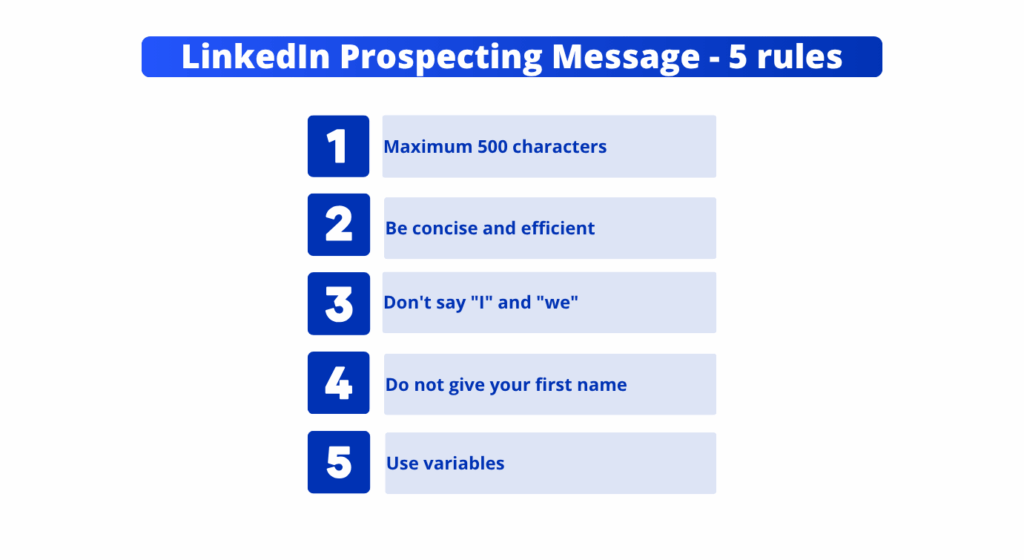
Here are the essential rules to follow for a follow-up that packs a punch:
- 1️⃣ A good follow-up message should be no longer than 500 characters.
- 2️⃣ Be concise and effective. Don’t use long sentences, avoid adverbs or any form of complex stylistic device that could be open to interpretation.
- 3️⃣ Don’t say “I” or “we.” Instead, focus on your prospects. Use “you” (or “you/your”) to speak to them directly.
- 4️⃣ Don’t give your first name, last name, or signature; all this information is already clearly visible on your LinkedIn profile.
- 5️⃣ Personalize your messages to make them more human. Use at least the {{Firstname}} variable, and possibly the {{company}} variable.
Some may shock or surprise you. All of these tips have been tested and are definitely approved.
And finally, here is a non-exhaustive list of polite phrases to avoid:
- Yours sincerely.
- Best regards.
- Looking forward to hearing from you.
- Best regards.
- Have a nice day.
- Thank you for adding me.
- Thank you for accepting my invitation.
- I’m following up with you.
- I would like to join your network.
- Did you receive my previous message?
- I would very much like to join your network.
- Thank you for accepting my connection request.
- Thank you for accepting my request to connect.
- I wanted to make sure you received my message.
How to write a successful LinkedIn follow-up message
First of all, your initial messages should have the same structure. Let me explain:
- 🟢 If your prospects haven’t seen or read your first message, then there’s no problem reusing its structure.
- 🔴 If your prospects have seen/read your first message but haven’t responded, it may be that your message wasn’t impactful or didn’t come at the right time.
Next, please avoid using phrases such as “Did you see my previous message?” Here’s why:
- If your first messages didn’t convert, this type of message won’t add anything new; it still won’t turn your prospects into customers.
- You’re wasting characters and losing the attention that your first words should be generating.
Worse, you will force them (the bravest ones) to make an effort to find your LinkedIn prospecting message.
The last follow-up message you send should change your strategy: your goal with this last message is to get a response at all costs (positive or negative).
To achieve this, you will need to create a pattern-breaking. 💔
A quick lesson: pattern breaking involves introducing something inconsistent (a break in form) into a familiar sequence, which confuses the person and makes them aware of something.
How can you create a pattern break in your LinkedIn prospecting messages?
By pattern break, we mean pleasantly surprising your prospect, stepping outside the box to capture their attention. 🧲
To do this:
- Change your tone, switching from formal to informal language (or vice versa).
- Introduce an unexpected element: a lighthearted GIF, an anecdote, a humorous remark, or a provocative (but respectful) phrase.
Why does it work? 🤔
Well, your conversation partner is used to traditional follow-ups. A change will make them pause and think.
Please note, I’m not saying you should act like the Joker; just add a little humanity and spontaneity.
Using this technique, you will have a number of people who may not appreciate the approach and who will respond (very) unfavorably.
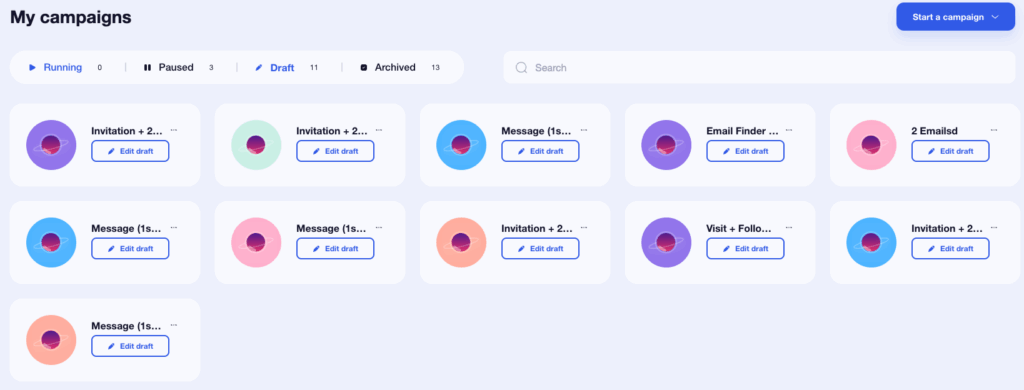
If you don’t know how to update a current campaign on Waalaxy, no worries, i got you!
Just go to “My campaings” and click on “Edit craft”, and there you go. 😇
However, there will also be a handful of profiles who will respond favorably, because you will have succeeded in capturing their attention. 🧠
13 LinkedIn prospecting message templates
Here are some LinkedIn prospecting messages templates you can use for your LinkedIn prospecting messages.
1) Example of a prospecting message: Painkiller
Hello {{Firstname}},
As [position], you are certainly one of those who [pain], tell me if I’m wrong.
I have created [free resource] that allows you to [benefit].
Would you like me to send it to you?
2) Painkiller variation
Hello {{Firstname}},
Several [position] like you have reported to me that they have difficulty [pain].
In the heat of the moment, I created [free resource] for [benefit].
Would you like to access it?
3) Sales LinkedIn prospecting message: FOMO
Hello {{Firstname}},
I created [resource] that explains how [competitor 1] and [competitor 2] do [benefit].
I thought this would be a good opportunity to share it with you at {{Company}}.
Are you interested?
4) Quick tip
Hello {{Firstname}},
Quick tip because I see you’re [position] at {{Company}}: [tip].
PS: It works really well!
5) LinkedIn prospecting message examples : Out-of-the-box
{{Firstname}},
You probably have 15 pompous prospecting messages in your inbox—so I’ll spare you a 16th. 😅
I just wanted to talk to you about [problem] at {{Company}}, how are you handling it?
6) Open question
Hello {{Firstname}},
I’ve noticed that [subject] is becoming a hot topic in the {{Company}} sector at the moment.
How is this impacting your business?
7) Example of a prospecting message: reverse approach
Hello {{Firstname}},
I was wondering what your job as [position] at {{Company}} entails?
I know what the job entails, but in general terms, what do you do on a daily basis?
8) Intriguing question
Hi {{Firstname}},
I wanted to ask you a question since you are [position] at {{Company}}.
What takes up most of your time today in [area]?
I would be interested to know how you operate.
9) LinkedIn sales message template : Human approach
To avoid sending you a long text (which you won’t want to read), I’ve prepared a short video (max. 3 min) to explain why I’m contacting you:
See you soon at {{Company}},
10) Findings
Hello {{Firstname}},
I recently read a [post/article/…] that said [X%] of [target audience] encounter [problem].
As I am interested in this topic, I am conducting my own research—and I was wondering: is your company, {{Company}}, one of them?
11) Pain-oriented question
Hello {{Firstname}},
I usually ask this question to [position]:
« What is your biggest challenge in [field]? »
I would be interested to know what is holding {{Company}} back.
12) Sales prospecting message: survey
Hello {{Firstname}},
I have spoken with a dozen [positions] over the past few weeks, all of whom have reported having difficulty managing [problem].
Is this also the case at {{Company}}?
13) Humorous
Hellooo {{Firstname}},
LinkedIn has recommended your profile at {{Company}} to me three times now—well, I hesitated, but this time it’s the right one 😂
I’d like to take this opportunity to ask you: what is your biggest challenge in [your field]?
Which Waalaxy campaign should you use for LinkedIn prospecting?
With Waalaxy, you can automate invitations, follow-ups, and even multi-channel messages (LinkedIn + Email), while controlling quotas and personalization.
So why not give it a try with one of your first outreach messages on LinkedIn using Waalaxy? 😏
Before we begin, here are four criteria to keep in mind:
- The number of touchpoints per campaign: too few (you lack impact) or too many (you annoy your prospects).
- The ideal type of invitation: this defines your level of engagement from the outset.
- The timing and spacing of messages and follow-ups: very important so as not to overwhelm your prospect.
- The channel mix (LinkedIn only or LinkedIn + Email): depending on your audience, some channels are more effective than others.
Here are two Waalaxy sequences that we recommend for LinkedIn prospecting message campaigns:
- 1️⃣ Invitation (with connection note) + 2 messages ⭢ ideal if you want to personalize the introduction a little and keep the approach light but targeted.
- 2️⃣ Invitation (without connection note) + 3 messages ⭢ ideal if you want to get straight to the point and have your first message directly convey added value.
PS: allow you to directly define whether you want 2 or 3 .
More than 4 messages in your sequence = risk of entering the “spammy” zone.
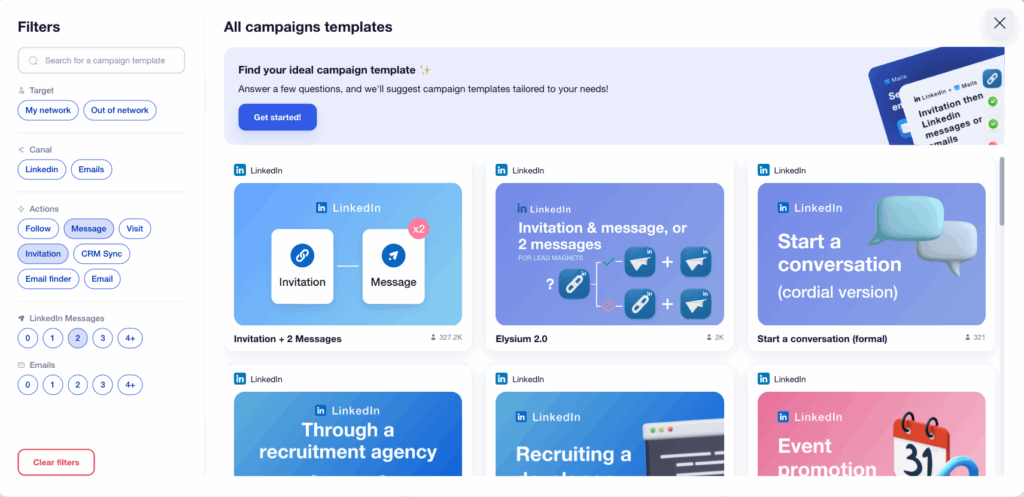
The question everyone is asking: should you include an invitation note or not? 🤔
Not including a LinkedIn connection request note means missing out on more than half of your prospects. 🫣
Acceptance rates vary between 30 and 50%, whereas if you manage to capture your prospects’ attention while conveying your value proposition in under 300 characters, you can expect a much higher acceptance rate.
In this case, 100% of your leads will be exposed to your offer. 🤩
Here’s a quick example. You are a B2B salesperson targeting marketing managers in SaaS, and you launch a sequence of “Invitation without note + 3 messages”:
- Message 1: hook + value proposition (see previous section).
- Message 2: gentle follow-up + additional benefit.
- Message 3: final message, pattern break (see next section on follow-up).
- Follow-up: you stop the sequence if the prospect responds and move on to conversation.
Quick recap
There you go! You now have everything you need to send LinkedIn prospecting messages that really make a difference:
- You know the winning structure (Catchphrase LinkedIn → value proposition → CTA)
- You know how to choose a smart sequence via Waalaxy for your LinkedIn/multi-channel campaigns.
- You have mastered the art of follow-up without being annoying. 😅
You have access to 13 ready-to-customize templates for your messages, so it would be silly not to use them!
And above all, don’t forget that prospecting is not a lottery. It’s about strategy, consistency, and a little bit of fun too.
| Key point | Why it’s important | To do now |
|---|---|---|
| Structure of the prospecting message. | Without a hook, value proposition, and CTA, the message falls flat. | Make sure each message follows these 3 steps. |
| Choice of Waalaxy campaign. | A poorly chosen sequence = poor results. | Opt for a sequence (e.g., invitation + 2 or 3 messages). |
| Follow up with a pattern break. | A standard follow-up is often ignored. | Add a « twist » or a different tone to your last message. |
| Ready-to-send templates. | The right message + the right time = more responses. | Choose 1 template, customize it, and launch it now. |
And if you want to try Waalaxy, you can do so for free!
FAQs About LinkedIn Prospecting Messages
What is a good opening line for a prospect?
A good prospecting opening line focuses on the prospect, not on you. The goal is to quickly show that your message is relevant and personalized.
Example: 👇🏼
“Hello {{Firstname}},
As a [position] at {{Company}}, you’re probably dealing with [pain point]. Let me know if I’m wrong.”
Why does this work?
🟣 It immediately personalizes the message by mentioning the prospect’s role and company.
🟣 It highlights a specific pain point the prospect can relate to.
🟣 It encourages a reply naturally without sounding too salesy or aggressive.
💡 The best opening lines spark curiosity and make prospects feel understood.
How do you write a LinkedIn prospecting message?
To write an effective LinkedIn prospecting message, follow this simple framework:
1️⃣ Research your prospect
Understand their role, company, industry, and potential challenges before reaching out.
2️⃣ Start with a personalized hook
Grab attention with a short sentence related to the prospect or their company.
3️⃣ Present a clear value proposition
Explain how you can help solve a problem or improve a situation.
4️⃣ Add a simple call to action
Ask for one small action, such as a quick 15-minute call.
5️⃣ Keep a human tone
Avoid generic templates, marketing buzzwords, and overly long paragraphs.
In short, successful prospecting combines personalization, relevance, and simplicity. 😇
How long should a LinkedIn prospecting message be?
A LinkedIn prospecting message should be short, personalized, and easy to read.
Ideally, keep your first message between 300 and 500 characters. The objective is not to sell immediately, but to start a conversation.
Focus on:
- personalization,
- a relevant pain point,
- a clear value proposition,
- and a simple call to action.
Shorter messages usually generate better response rates because they feel more natural and less promotional.
What should you avoid in LinkedIn prospecting messages?
Avoid sending generic, overly sales-oriented, or excessively long messages.
Common mistakes include:
🔴 Talking only about your product or company.
🔴 Using copy-paste templates without personalization.
🔴 Writing long paragraphs.
🔴 Adding multiple calls to action.
🔴 Sounding too aggressive or pushy.
The best LinkedIn prospecting messages feel conversational, relevant, and tailored to the prospect’s needs.
Is there an alternative to LinkedIn messaging?
Yes, several tools can improve the LinkedIn messaging experience and help automate prospecting workflows.
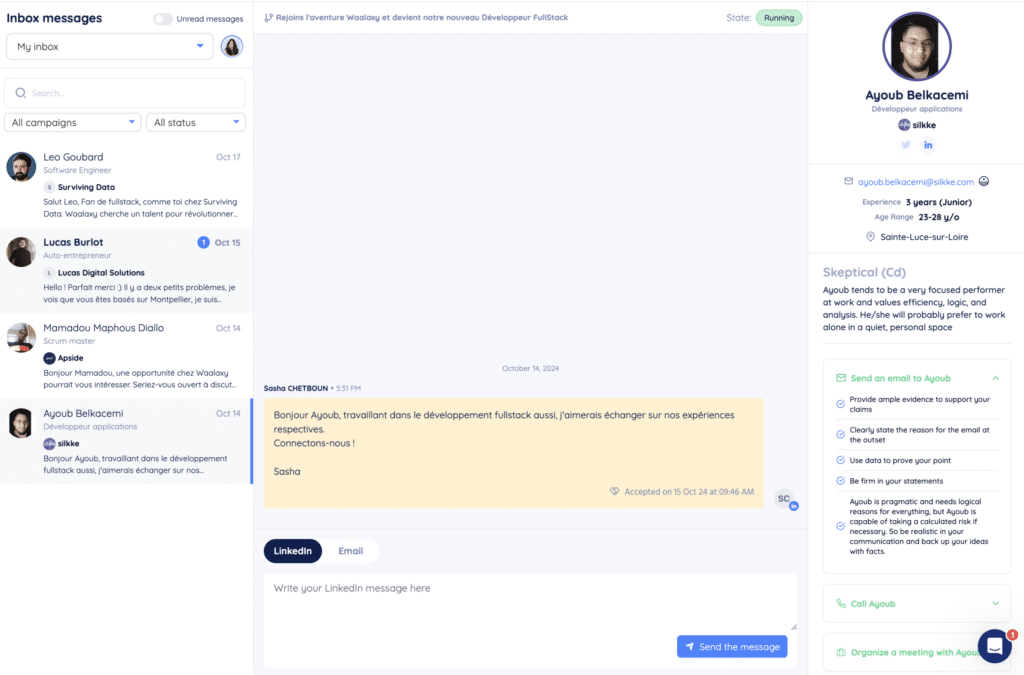
For example, Waalaxy developed Waalaxy Inbox, a messaging solution designed for LinkedIn prospecting. 📮
It includes features such as:
🟣 Automated follow-ups.
🟣 Integration with Waalaxy campaigns.
🟣 GIFs, emojis, and link support.
🟣 Prospect tagging and organization.
🟣 Message scheduling.
🟣 Saved replies for faster communication.
 Ophélie
23/06/2026
Ophélie
23/06/2026