

- What is Account Based Selling?
- ABS vs. traditional prospecting vs. ABM Marketing
- Account based selling benefits for B2B
- Account based selling challenges and risks
- The 7 steps to deploying an Account based selling strategy
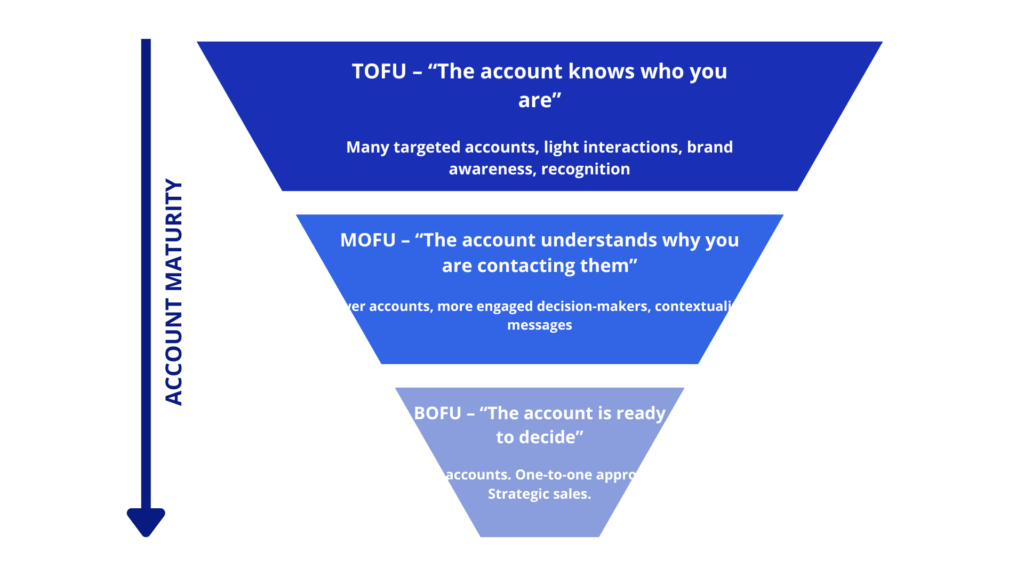
- How to structure ABS according to the funnel (TOFU/MOFU/BOFU)?
- How sales automation supports account-based selling ?
- 3 Account based selling best practices
- Let’s recap ABS, shall we?
- FAQ
Traditional B2B prospecting quickly reaches its limits: too many leads, few qualified ones, overworked salespeople, and sales cycles that drag on. 😮💨
When the value of a deal is high and several decision-makers are involved, casting a wide net is no longer the right strategy.
This is exactly where Account Based Selling (ABS) comes into its own! I’ll explain what it is and how to implement it in just seven steps. 👀
What is Account Based Selling?
Account-Based Selling is a B2B sales approach that focuses on accounts rather than leads. The goal is no longer to generate as many contacts as possible, but to concentrate sales efforts on a limited number of strategic accounts, with a much more personalized approach. 🧚🏻♀️
This shifts the focus from volume to value, where each sales action is designed to move a specific account forward in the decision-making cycle. 🍃
What is account-based selling ?
ABS is based on a simple idea: not all accounts are equal! Rather than treating every prospect the same, you identify the companies with the strongest business potential… and tailor your approach to their specific challenges. 🎯
This involves 👇🏻:
- Precise targeting of high-value accounts.
- Personalized messages tailored to the account context.
- Alignment between sales and marketing teams to speak with one voice.
What types of B2B sales is it suited to?
Account-based selling is particularly suited to environments where:
- The average basket size is high. 💸
- The sales cycle is long. 🌪️
- Several decision-makers are involved in the decision. 🙆🏻♀️
- The business relationship is long-term. 🤝
This is often the case in complex B2B sales, mid-market or enterprise SaaS, high value-added services, and technical or strategic solutions.
ABS vs. traditional prospecting vs. ABM Marketing
Before deploying an Account Selling strategy, it is essential to understand how this approach differs from traditional models. Not just in terms of rhetoric, but in terms of execution logic, objectives, and above all, business impact. 📈
The most common mistake? Comparing these approaches as if they were completely opposed, when in reality they respond to different needs depending on the B2B context.
Traditional prospecting
Traditional prospecting is based on a simple logic: the more leads you contact, the more likely you are to close a deal. ✍️ Cold emails, outbound calls, mass automation… everything is designed to generate volume. 📬
➡️ The problem, especially in B2B:
- Many leads are poorly qualified.
- Little context on the prospect‘s real challenges.
- Salespeople drowning in follow-ups.
- Sales cycles that are often ineffective.
This approach may work for simple or low-value offers, but it quickly shows its limitations when the decision becomes complex. 😬
ABS, a sales-driven approach
Account-Based Selling completely changes the perspective. Here, the goal is no longer to “push” as many leads as possible into the funnel, but to move specific, targeted accounts forward. 📊
ABS is primarily driven by sales teams:
- Choosing high-potential accounts.
- Detailed understanding of the account context.
- Personalized and progressive approach.
- Monitoring performance at the account level, not the contact level.
Fewer unnecessary actions, but more impact on high-value deals. In fact, 48% of organizations using an account-based strategy see a higher closing rate.
ABM, a complementary marketing approach
ABM (Account-Based Marketing) adopts a similar approach… but with a different role. Whereas ABS focuses on sales strategies and direct relationships, ABM focuses more on 👇🏻:
- Awareness among target accounts.
- The creation of personalized content.
- Influencing decision-makers upstream of the cycle.
The two approaches are not competitive, but complementary. 🤝
Here’s a quick recap:
| Criterion | Traditional prospecting | Account-Based Selling (ABS) | Account-Based Marketing (ABM) |
|---|---|---|---|
| Main logic | Volume of leads | Value per account | Visibility and influence |
| Target | Individual leads | Strategic accounts | Strategic accounts |
| Driven by | Sales team | Sales team | Marketing team |
| Level of customization | Low to medium | High | High |
| Number of accounts | Large | Restricted and qualified | Restricted and qualified |
| Sales cycle | Short to medium | Medium to long | Upstream of the cycle |
| Main objective | Generate opportunities | Close high-value deals | Prepare and nurture accounts |
| Key KPIs | Volume of leads, appointments | Closing rate, ACV, ROI | Engagement, brand awareness |
| Suitable for complex sales | ❌ | ✅ | ✅ |
Account based selling benefits for B2B
Account-Based Selling is becoming increasingly popular in B2B organizations, and not just because it’s trendy.
It’s mainly because it’s much better suited to the realities of complex sales. 🤝
Where traditional prospecting seeks to optimize volume, ABS optimizes commercial impact.
Fewer leads, but more qualified
One of the main benefits of ABS is that instead of managing hundreds of immature leads, teams can focus on a limited number of accounts that are truly aligned with the offering. 🎯
You waste less time on qualification, have more relevant exchanges, and conversations that move forward more quickly. 😇
More controlled sales cycles
Yes, ABS often involves longer sales cycles at the outset. But above all, they are much more predictable. Why?
- Decision-makers are identified earlier. 👀
- The issues are better understood. 🫡
- Customer objections are anticipated. 😎
- Actions are coordinated at the account level. 🕺🏻
You no longer endure the sales cycle: you drive it! 🧭
Better sales ROI
This is often the argument that ultimately convinces decision-makers. By focusing efforts on high-potential accounts, ABS helps increase:
- The average value of contracts. 📈
- Customer lifetime value. 🙌🏻
- The overall effectiveness of sales teams. 👯♀️
89% of organizations say that an account-based strategy generates a better ROI than traditional approaches. 💸
More natural sales and marketing alignment
Account-based selling forces a positive cultural change, with sales and marketing teams finally working on the same accounts with the same priorities. 🤝
Marketing no longer generates “disconnected” leads, and sales teams no longer work in silos. That’s why 67% of B2B organizations report better sales and marketing alignment with ABS 🤩.
Account based selling challenges and risks
Account-based selling is powerful, but it’s not a magic solution. If executed poorly and/or launched too quickly, it can even become counterproductive.😬 The goal here is not to discourage you, but to help you avoid common pitfalls.
1. It’s an approach that requires more resources
ABS requires more than just launching a sequence of automated emails. It involves:
- Time to analyze accounts.
- Skills to personalize messages. 📨
- Real coordination between sales, marketing, and operations. 🙌🏻
For some teams, especially those in the structuring phase, this can represent a significant initial investment. ⏳ That’s why ABS works best when deployed on a controlled scope, not across the entire sales pipeline from the outset.
2. Less immediate results
Unlike mass prospecting, ABS does not promise instant results. The first intent data is often:
- Engagement. 💕
- More qualitative responses. 📮
- More strategic discussions. 🗣️
Concrete opportunities usually arise after several weeks or even months.
This is normal, as you are dealing with complex accounts involving multiple decision-makers and long decision cycles. 🧠
👉 ABS is a medium/long-term investment, not a quick win.
3. The risk of poor targeting with limited segmentation
This is probably the most significant risk. When working with a limited number of accounts, every targeting error is costly. 🥲
A poor fit can lead to 👇🏻:
- Demotivation of sales teams.
- A loss of revenue.
The 7 steps to deploying an Account based selling strategy
Implementing an Account-Based Sales strategy is not about stacking tools or sequences. Above all
, it is a structured approach that aims to advance specific accounts over time, with consistency. 🧠
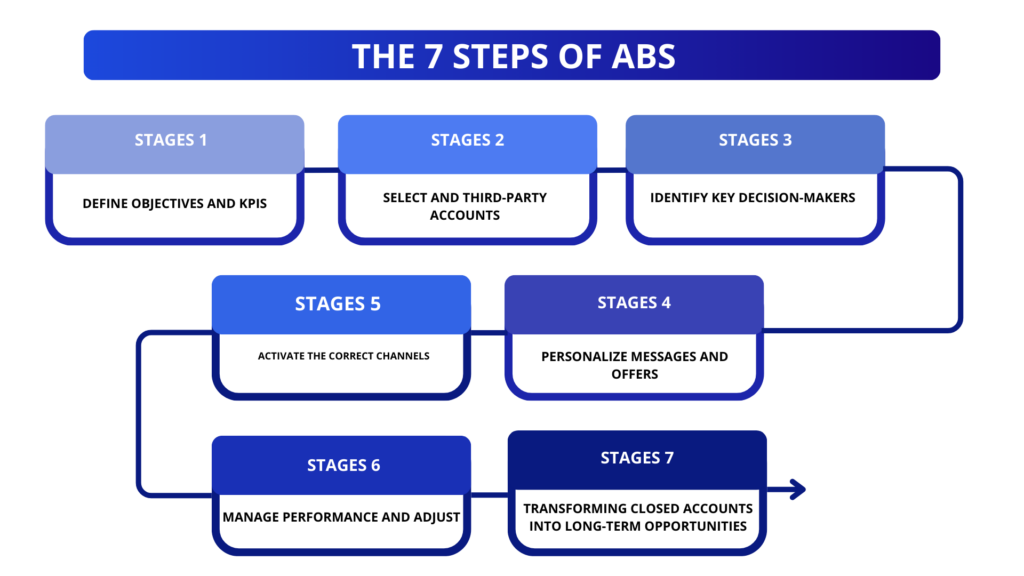
Step 1: Define objectives and KPIs
Before even talking about accounts or messages, you need to clarify what you really expect from ABS.
What is your ideal customer profile ? Are you looking to sign fewer but bigger deals? To reduce the length of the sales cycle? To better prioritize sales efforts? 😅
KPIs should be thought out at the account level, not just the lead level. For example: account engagement, conversion rate per account, average contract value, or closing speed. 📊
Step 2: Select and tier stakeholder
Not all accounts deserve the same level of effort. Account Based Selling is built on a simple principle: smart prioritization. Most teams operate using a tiered account approach 👇🏻:
- A few highly strategic accounts with an in-depth approach.
- A second level with a lighter level of personalization.
- A broader scope with semi-automated actions.
This step is key, as it determines the workload and overall profitability of the strategy.💡
Step 3: Identify key decision-makers
A B2B sale is rarely won with just one person. At ABS, we seek to understand who really influences the decision within the account: business decision-maker, user, finance, management, etc.😅
The goal is not to contact everyone, but to map out the decision-making committee to tailor the pitch to each role. This is often where traditional strategies fail and ABS makes the difference. 🤓
Step 4: Personalize messages and offers
Personalization in ABS is not limited to inserting a first name or company name. It’s about showing that you understand 👇🏻:
- This involves understanding the context of the account.
- Its specific challenges.
- The account demonstrates maturity in the decision-making process.
Good personalization relies more on the relevance of the message than on its level of detail.
It’s better to make an accurate assumption than to send a message that is too long and too complex… 😊
Step 5: Activate the right channels
ABS rarely works on a single channel. The most effective approaches generally combine:
- Social interactions (LinkedIn).
- Contextualized emails.
- Targeted sales outreach.
The challenge is not to be everywhere, but to be in the right place at the right time, something clearly illustrated by many account based selling examples, depending on the decision-maker’s profile and the account’s maturity level. 👵🏼
Step 6: Monitor performance and adjust
An ABS strategy is never set in stone. It is managed over time, observing pain points and what really works at the account level. Certain indicators quickly become central: multi-decision-maker engagement, progress in the sales funnel, speed of conversion.
It is this “ account-centric” that allows you to adjust messages, channels, or prioritization without starting from scratch. 🔄
Step 7: Turn closed accounts into long-term opportunities
ABS doesn’t stop at the signature. A won account often becomes a lever for sustainable growth: upsell, cross-sell, renewal, recommendation.
The most mature teams use ABS to strengthen the relationship over time, tailoring post-sale actions to the same level of personalization as the initial prospecting. 🤝
How to structure ABS according to the funnel (TOFU/MOFU/BOFU)?
One of the big pitfalls of Account-Based Selling is wanting to move too fast. Not all actions are equal depending on the maturity level of the account, and applying the same pitch at every stage of the funnel often means missing out on opportunities. 🥲
1. ABS in TOFU: Create visibility and credibility
In TOFU, the goal is not to sell, but to exist in the mind of the account. You are looking to establish initial recognition, to show that you understand the challenges of the sector, without forcing the conversation. 😊
➡️ At this stage, ABS actions are mainly used to:
- Initiate light interactions.
- Capture the first signs of interest.
- Create a favorable context for the future.
An account that recognizes your name and expertise is already an account that is moving forward in the funnel, even without a direct response. 🙌🏻
2. ABS in MOFU: Engaging in personalized conversations
MOFU marks a real change in approach. We move from visibility to exchange, with more contextualized messages and a clearly business-oriented approach. 💰
This is often where ABS reveals its full usefulness because instead of relying on a single contact, you engage several decision-makers from the same account, each with an angle tailored to their role. 😌
The goal is not yet to close the deal, but to identify the real issues, gauge interest, and position your solution as credible and relevant. 🥸
3. ABS in BOFU: activate a one-to-one approach
In BOFU, Account Based Selling becomes a strategic, almost tailor-made sales approach.
The account is identified, engaged, and close to a decision… this is where every detail counts. 🫣
Actions are more targeted, more direct, and often coordinated between several contacts on the client side. The goal is no longer to convince, but to reassure, align, and accelerate. This is also when ABS helps reduce classic friction points: late objections, forgotten decision-makers, and unnecessary back-and-forth. 🫠
How sales automation supports account-based selling ?
Account-based sales is often perceived as a difficult approach to scale. And that’s true… if everything is done manually. 😅 But with the right tools, ABS allows you to combine personalization, controlled volume, and sales performance.
Why use automation in ABS?
In an ABS strategy, many actions are repetitive: targeting, qualification, follow-ups, interaction tracking, account scoring… Without automation, these tasks quickly become time-consuming and limit the ability to handle multiple accounts in parallel. ⏳
Automation allows you to 👇🏻:
- Save time on targeted prospecting.
- Structure consistent multi-touch journeys.
- Track engagement at the account level.
- Prioritize sales efforts based on detected signals.
It is also a key lever for ensuring reliable execution, especially when several salespeople are working on similar accounts. 😌
How does Waalaxy enable ABS to be executed on a large scale?
Account based selling tool like Waalaxy make Account Based Selling strategy truly operational, even with small sales teams. Where some tools are limited to emailing, Waalaxy was designed as an all-in-one alternative, combining LinkedIn and email.
The goal is not to add complexity, but to simplify the execution of Account Based Selling.
From a single platform, you can manage your targeted prospecting without multiplying tools, connections, or processes. 👌
In concrete terms, Waalaxy allows you to structure a complete ABS strategy :
- Precise targeting of accounts and decision-makers on LinkedIn and Sales Navigator.
- Prioritization based on detected engagement.
- Multichannel actions (invitations, messages, follow-ups, emails).
- Customization based on account, role, and funnel stage.
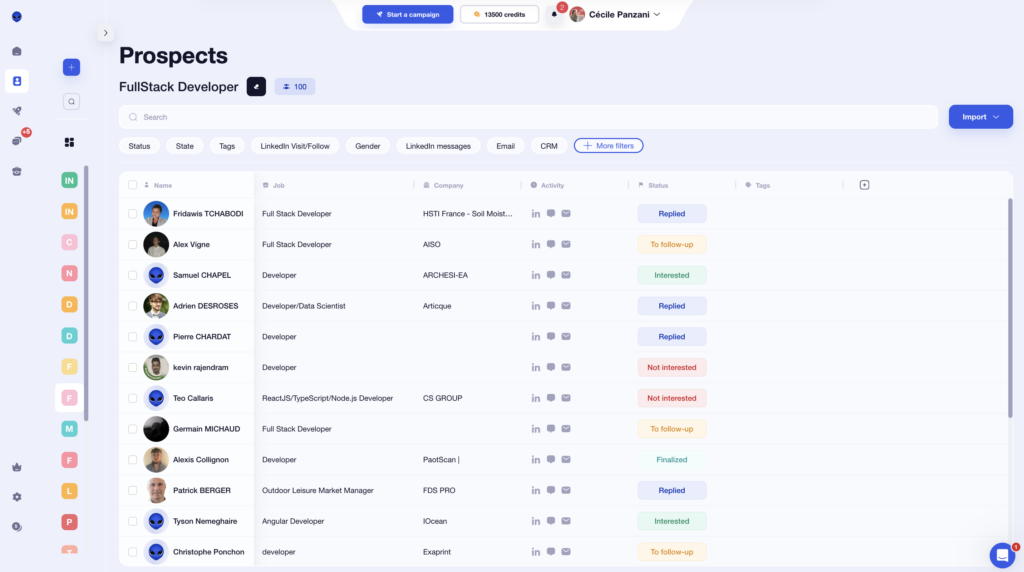
Sequences are preconfigured and comply with “safe”, allowing you to work on accounts over time without risking being blocked by LinkedIn. 🧘🏻♀️
Waalaxy has also been designed for teamwork. Team plans facilitate collaboration between multiple users: shared campaigns, common templates, shared lists… everyone retains their autonomy while respecting a clear framework. 💼
Finally, all LinkedIn responses are centralized in a unified inbox with tags. This helps salespeople focus on high-potential accounts and manage Account Based Selling with confidence. 🧘🏻♀️
3 Account based selling best practices
Account-based selling works when it is designed as a sustainable strategy, not as a one-off action. 😊 Here are the principles that really make a difference:
- Make patience a competitive advantage: ABS takes time, but it builds stronger relationships. Accepting longer cycles is often the price you pay for signing bigger and more sustainable deals. 🤝
- Take care of data and CRM: In ABS, you work on a small number of accounts, so data quality becomes critical. A well-structured CRM allows you to track engagement at the account level, share information between teams, and manage performance without guesswork. 📊
- Align sales, marketing, and ops: ABS naturally requires internal alignment. 🕺🏻
Let’s recap ABS, shall we?
Account-based selling is not just another prospecting method, but a true sales approach built as an account based selling system. Rather than trying to reach everyone, you focus your efforts where the business impact is real. 🎯
When it’s well-targeted, well-structured, and supported by the right tools, this account based selling system helps you better prioritize accounts, align teams, and secure high-value deals over the long term. If your current prospecting generates too much noise and not enough results, it may be time to move from a volume-based approach to a value-driven one. 😅
FAQ
What is customer-based selling?
Customer-based selling refers to an approach focused on existing customers, with the goal of developing value over time (upselling, cross-selling, social selling, retention). Account-based selling goes further: it applies to both prospecting and strategic account development, with an account-centric approach from the outset. 😎
How long does it take to see results with ABS?
ABS is not an instant lever. In general, the first signs appear within 30 to 60 days (engagement, positive responses), while concrete business results are measured over 3 to 6 months, depending on the complexity of the sales process. ⏳
What signs indicate that an account is ready for ABS?
An account becomes relevant for Account-Based Selling when it shows clear signs of intent, such as👇🏻:
- Several committed or identified decision-makers.
- Repeated interactions with your messages or content.
- Business challenges or credible timing.
These signals (intent data, contact, account maturity, etc.) allow you to prioritize your efforts and activate ABS at the right time! 🧠
Now you know everything there is to know about Account-Based Selling (ABS). 🧚🏻♀️
 Lisa
23/01/2026
Lisa
23/01/2026