

- What is buy email list?
- Is buying an email database legal?
- The real risks of buy email list
- How to test a buy email list without taking risks?
- Safer, legal, and more profitable alternatives to buy email list database
- KPIs and realistic expectations: how to evaluate performance?
- Let’s do a recap on buy email lists
- FAQ about buy email list
Thinking about a buy email list approach to speed up your lead generation? 🤔
It’s tempting, especially when the pressure rises and the pipeline needs to fill up fast.
But be careful: between GDPR, technical risks, and sender reputation issues, a purchased list can either help you… or put you in a bad spot very quickly 😬.
In this article, we explain what you can do, what you absolutely shouldn’t do, and how to avoid the traps, while giving you safer and more profitable alternatives 👀.
What is buy email list?
A purchased email list is simply a database of contacts you buy from an external provider, data agencies, brokers, specialized platforms, or sometimes… less transparent “resellers” 😅.
These lists usually contain 👇🏻:
- Email addresses (B2B or B2C)
- Names, job titles, phone numbers
- Company information
- “Enriched” data pulled from multiple sources
The problem? You have zero relationship with these contacts. They don’t know you and didn’t ask for anything, and that changes everything, for your deliverability rate and… for the law 👨🏻⚖️.
Why do companies look to buy email list solutions?
When businesses turn to this, it’s usually out of necessity. Buy email list feels like a shortcut when things need to move fast, especially in situations like:
- 📋 A pipeline that’s too light, with strong pressure to generate opportunities quickly.
- 📉 Not enough traffic or inbound marketing, making natural customer acquisition difficult.
- 🎯 Ambitious sales targets that push teams to artificially increase prospect volume.
- 😅 C-level pressure, expecting immediate results.
- 👩🏻💻 Limited internal resources, making long-term strategies harder to deploy.
In moments like these, buying a list seems to fix the problem: a large volume of contacts, instantly available, with no acquisition effort or waiting time. That’s why many marketing, sales, or growth teams consider this option when the pace picks up.
The different types of email lists you can buy
In practice, several types of buy email list options are sold on the market 👇🏻:
- 👨🏻💼 B2B databases: Made of business/professional emails (firstname.lastname@company.com), commonly used for sales outreach.
- 🙆🏻♀️ B2C databases: Containing personal emails (Gmail, Outlook…), far riskier and heavily regulated by law.
- 💸 List rental: The provider sends the email campaign for you, and you never see the addresses. The legal risk drops, but so does the ROI.
- 📝 “Opt-in” lists: The provider claims the contacts have given consent. In reality, they almost never agreed to receive your emails or hear from your business.
- 🗒️ Enriched databases: A mix of data collected via scraping, partners, APIs, or aggregators. Quality can vary a lot, sometimes from one row to the next.
In every case, buying a list means contacting people who never asked to hear from you. Technically, it can work… but often at the cost of high risks. 🥲
Is buying an email database legal?
It’s the question everyone asks… and the answer isn’t a simple “yes” or “no.” Buy email list itself isn’t explicitly illegal in the US. What can become illegal or put you at serious risk is how you use it. 👀
Why? Because regulations like the CAN-SPAM Act, CCPA/CPRA, and several state-level privacy laws impose strict rules around permission, transparency, and data sourcing. 🕵🏻
CAN-SPAM in practice
Under US law, you can send commercial emails without prior opt-in, but that doesn’t make buying email lists safe. CAN-SPAM requires full transparency: accurate sender identity, truthful subject lines, clear intent, and a functioning opt-out. If any of these are missing, your emails become non-compliant.
Here’s what CAN-SPAM requires 👇🏻:
- Clear identification: Your “from” field must be accurate, with no misleading information.
- Truthful messaging: Your subject line must reflect the real content.
- Transparent data use: You must disclose who you are and include a valid physical address.
- A working opt-out: Recipients must be able to unsubscribe easily, and you must comply within 10 business days.
The real issue with most buy email list providers? You often have no reliable proof of how emails were collected and that’s where things get risky. Even if the seller claims the data is “opt-in,” it usually has no legal weight under US laws. 😬
What about CCPA/CPRA?
If you target or store California residents’ data, you must be able to show:
- Where did the data originate?
- How was it collected?
- Whether individuals were allowed to opt out of data sales.
- Whether you can delete their data on request.
Purchased lists almost never provide this level of transparency.
B2B vs B2C: what changes when you buy an email list
In B2C, it’s simple: sending marketing emails to consumers is heavily regulated in the US. While CAN-SPAM doesn’t require explicit opt-in, buying a consumer email list or sending campaigns to personal addresses is extremely risky. Most B2C lists are scraped, resold, or collected without proper notice, even if the seller claims they’re “100% compliant.” 😅
For B2B, the rules are a bit more flexible under US law. You can email a professional address without prior consent as long as you follow CAN-SPAM and the message is relevant to their role. But that doesn’t exempt you from transparency requirements and more importantly, you must still be able to justify where the data came from. Most providers can’t give you this information.
In other words, even in B2B, a purchased list remains very hard to use safely or legally when you rely on a bought email list for marketing strategy. 🤓
The rare cases where buy email list is tolerated
There are a few scenarios where purchasing data can be acceptable in the US but only if you don’t send direct marketing emails to the individuals:
- 🧳 Buying purely “business” data (company size, industry, revenue, identifiers) with no personal information attached.
- 📮 Generic corporate emails (contact@, info@) when the address does not identify a specific person.
- 📊 Market research, or statistical enrichment, where the data is never used for outreach.
- 📋 Building an internal knowledge base, without any direct communication to the contacts.
These cases remain very limited and never sufficient to justify a full buy email list outreach strategy. The moment personal data or identifiable emails are involved, the legal and technical risks rise sharply.
The real risks of buy email list
Buying an email database may look like a time-saver… but in reality, it’s often one of the fastest ways to run into trouble 😅.
The technical risks of buying an email list
This is where most companies hit the wall. A prospecting database almost always contains dead addresses, outdated data, or even traps. The result 👇🏻:
- Massive bounces that destroy your sender reputation.
- Spam traps that can get your domain blacklisted.
- Your emails are going straight to spam, even for your real subscribers.
One poorly executed campaign can damage your domain for weeks. And recovering from that is painfully difficult 😬.
The business risks of buying an business email list
Contacts from a purchased list don’t know you. They never asked for your emails. So you inevitably get:
- Low open rates.
- Very few clicks.
- Almost zero replies.
Most companies that try a buy a email list approach eventually admit the ROI is basically nonexistent… even though it seemed like a “good idea” at first. 😒
The legal risks of purchase an email list
In the US, laws like CAN-SPAM, CCPA/CPRA, and various state privacy regulations shift the responsibility onto you, not the vendor.
What makes a purchased list risky is the combination of strict US requirements and the lack of transparency that usually comes with these databases, especially when you plan to use them for a prospecting campaign. CAN-SPAM demands truthful identification, clear intent, and a working opt-out, while CCPA/CPRA requires you to know and disclose exactly how the data was collected and to delete it on request. 👀
The problem is simple: bought lists rarely provide this level of traceability. If the emails were scraped, resold without notice, or collected improperly, you are the one held accountable, not the provider.
Regulators can penalize for 👇🏻:
- Misleading sender identity.
- Unsolicited commercial emails.
- Failure to honor opt-outs.
- Lack of transparency about data sources.
And penalties can sting 💸:
- CAN-SPAM fines can reach $51,744 per email in violation.
- CCPA/CPRA allows fines up to $7,500 per intentional violation.
- Blacklisting or domain damage can cost far more in lost revenue.
US authorities have already penalized companies for far less than using a purchased list… so it’s definitely not something to gamble with 🙃.
How to test a buy email list without taking risks?
If you still decide to test a buy email list USA despite the risks, you need to do it in a controlled and secure way and especially without exposing your main domain. The goal is to evaluate the quality of the list before putting your sender reputation on the line. Here’s a simple 5-step method. 🧚🏻♀️
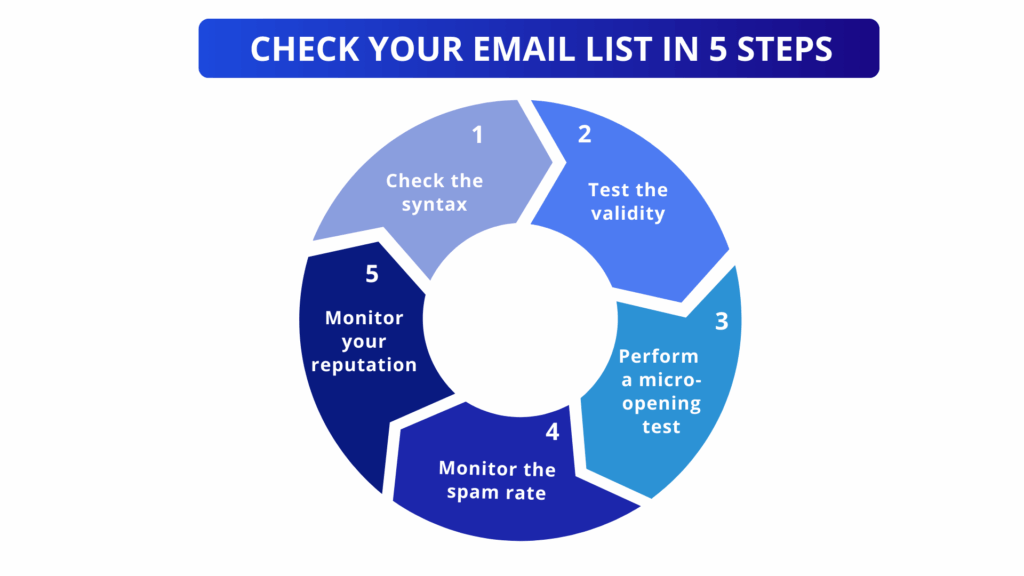
1. Run a syntax check
First step: clean out everything that is obviously wrong, especially if you just bought the email list. It’s quick but essential. This catches malformed addresses, typos, non-existent domains, disposable emails… 🚮
If more than 5–10% of the list is invalid, that’s already a red flag. 🚨
2. Test for validity
Use an email validation tool to verify the quality of your purchased email database. These tools detect 👇🏻:
- Inactive addresses.
- Spam traps.
- Dormant domains.
- Likely bounces.
If more than 3–5% of the list is flagged, that’s a sign the buy email list source is risky and sending anything to it could harm your deliverability. 😅
3. Run a micro-open test
Never with your main domain. Create an “alias” domain (for example: yoursite-mail.com) specifically for testing. Send a tiny sample, around 100 to 200 emails, with a soft, neutral message just to measure engagement. 🤓
➡️ KPIs to watch:
- Open rate > 20%.
- Bounce rate < 3%.
- Zero spam complaints.
Anything below that is a warning sign. 🚨
4. Closely monitor spam rates and complaints
Spam complaints must stay below 0.1%. Above that threshold, email providers start tagging you as a risky sender. A single poorly rated test campaign can push all your emails into spam, even the ones sent to your real subscribers. 🥲
5. Monitor your reputation for 48–72 hours
After testing, track your sender reputation through 👇🏻:
- Google Postmaster Tools.
- Microsoft SNDS.
- GlockApps.
- Mail-Tester.
If you notice a drop in reputation, unusually low open rates, or any warnings… stop immediately 🙅♂️. Better to ditch a shady prospect lists than destroy your email deliverability for months.
Example message to send after buying an email list
If you still want to try a clean approach, you can send a re-permission email. The goal isn’t to sell, it’s simply to ask whether the person agrees to receive your messages. 📨
Subject: May I contact you? 😊
Hello,
Your address appears in a professional database provided by a partner.
Before sending you anything, I prefer to ask for your permission directly. Would you like to receive our resources, tips, and information related to [your topic]?
👉 Yes, I’m interested.
👉 No thanks.
I will only contact you if you choose to opt in.
Have a great day,
[Signature]
6 tools to test your purchased email list
Before testing a database, you need the right tools to verify quality, reputation, and the health of your domain. Here are my must-haves 👇:
| Tool | Main use |
|---|---|
| ZeroBounce | Email validation (bounces, quality, risk scoring) |
| Dropcontact | Enrichment + smart cleanup |
| GlockApps | Reputation monitoring & inbox placement |
| Mail-Tester | Spam score & technical diagnostics |
| Google Postmaster Tools | Domain reputation & deliverability insights |
| Microsoft SNDS | IP reputation & spam alerts |
Safer, legal, and more profitable alternatives to buy email list database
Good news: you don’t need to buy list email to generate leads quickly. There are 100% legal methods that perform far better… and most importantly, protect your deliverability rate 🤝.
Here are the alternatives that truly work today and that often cost less than a questionable “opt-in” file 😅.
How to build an opt-in email list?
This is the safest, most scalable, and most profitable long-term solution. Here are the best sources of high-quality emails 👇🏻:
- Landing pages with a clear offer (eBook, template, checklist…).
- Webinars, online events, and masterclasses.
- A newsletter with a strong promise (👉 “sign up to get X benefit”).
- Useful, easy-to-digest lead magnets (PDFs, tool lists, scripts…).
- Contextual forms placed on your website or inside your content.
➡️ Lists built this way typically deliver:
- 30–50% open rates.
- 3–10% click-through rates.
- Far more qualified replies.
And above all… they grow your audience without the risks tied to any buy email list approach.
Automatically generate qualified contacts via LinkedIn
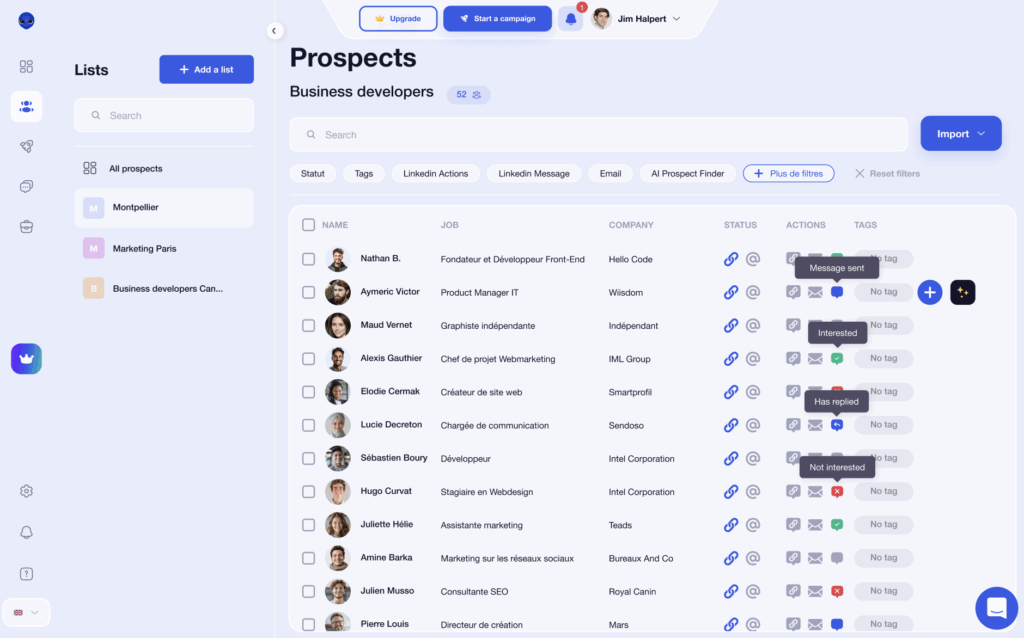
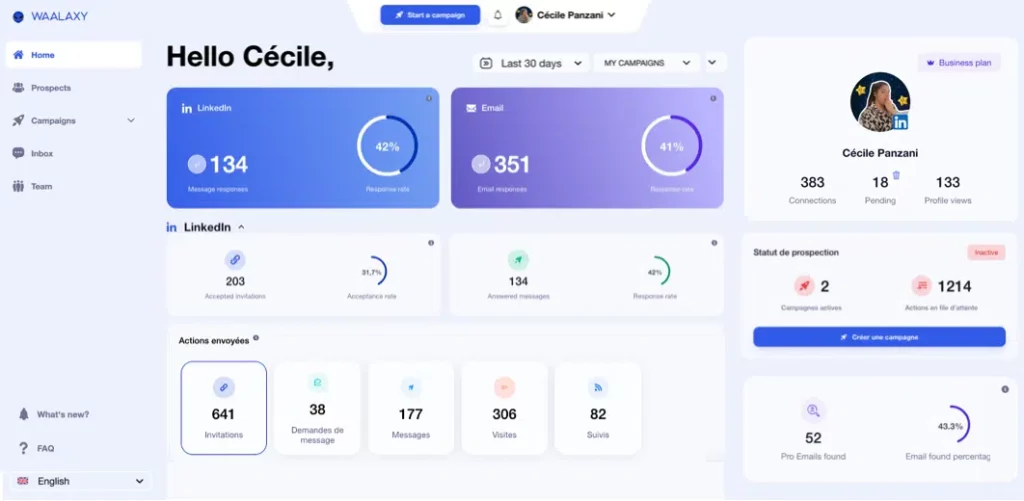
This is the strategy to build a free, reliable email database. With a tool like Waalaxy, you can 👇🏻:
- 🙆🏻♀️ Identify your ICP directly on LinkedIn (job title, industry, company size).
- 📝 Automatically export these profiles into your campaigns.
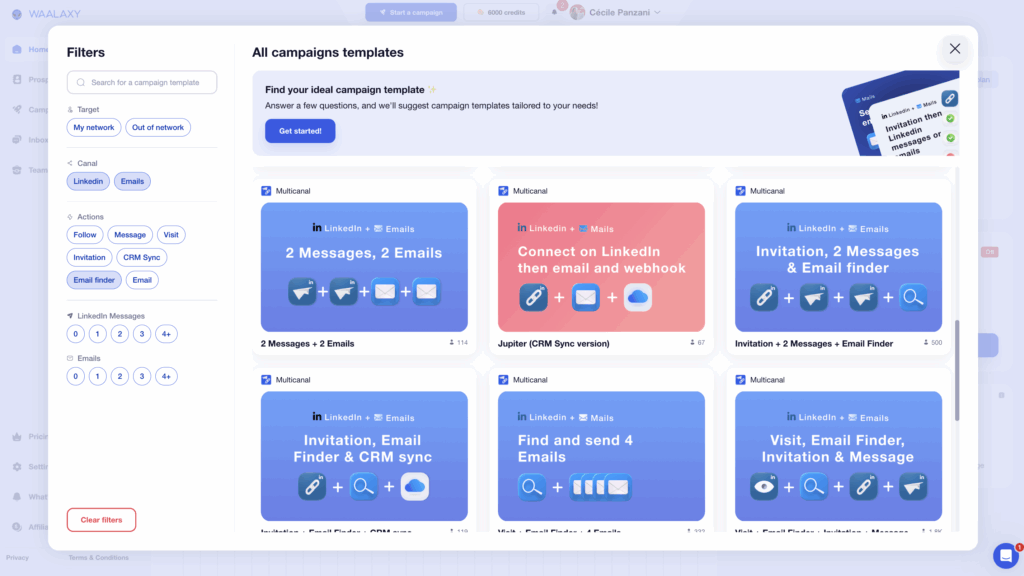
- 📮 Launch cross-channel sequences (LinkedIn + email).
- 😎 Use an Email finder to easily retrieve your leads’ professional email addresses.
- ✅ Enrich each contact with a verified email.
- 🗒️ Build a fresh, qualified, continuously updated database.
All of this without relying on shady brokers or “magic” lists sold at $300 per thousand 😅.
Real case:
A SaaS SMB was hesitating to buy 10,000 emails.
Instead, they used Waalaxy and built 3,000 ultra-targeted contacts (clear ICP: Heads of Ops / industrial SMBs), launched LinkedIn + email sequences, got 38% reply rates, and generated 4× more pipeline than with the purchased list they had tested earlier (which produced a 2% reply rate… and tanked their deliverability because of high bounce rates). 😎
Less volume, but much more business.
Other effective, growth-friendly, and compliant alternatives
If you want to move faster without destroying your deliverability, here are complementary strategies that really work 👇🏻:
- Co-marketing: Visibility swaps with a complementary company.
- Evergreen content: SEO-optimized articles that attract leads continuously.
- Content partnerships: Shared guides, webinars, or newsletters.
- Hyper-targeted cold outreach, triggered by signals (hiring, funding rounds, recent news).
- Newsletter sponsorships in your niche (super effective for reaching a warm audience).
- Legally scrape public data, as long as you respect US privacy rules and send only relevant B2B outreach.
All these methods have one thing in common: you start from a fresh, targeted, legitimate source not a recycled list sold 15 times to other sales teams… ✨
KPIs and realistic expectations: how to evaluate performance?
Whether you buy a list or build your own audience, it’s essential to track the right indicators.
| KPI | Purchased list | Opt-in / targeted list | Achievable goals |
|---|---|---|---|
| Deliverability 📩 | 70–85% | 95–99% | > 95% |
| Open rate 👀 | 10–20% | 30–50% | > 30% |
| Click rate 🖱️ | 0.2–1% | 2–10% | > 2% |
| Reply rate 💬 | 1–3% | 20–40% | > 15% |
| Spam/complaints 🚫 | 0.3–0.7% | 0.01–0.05% | < 0.1% |
| ROI 💰 | Low / negative | 3× to 5× | Positive ROI |
Let’s do a recap on buy email lists
Buying an email database may look like a shortcut to generate leads, but in 90% of cases, it’s mostly a trap 😅. Between US privacy rules, lack of consent, spam traps, and reputation risks… a purchased list usually causes more damage than opportunities. 🥲
Yes, you can run tests to limit the impact but even perfectly cleaned, a purchased list will never perform like a fresh, qualified, fully opt-in audience. You can create far more value, replies, and revenue by building your own audience through 👇🏻:
- Targeted growth marketing strategies.
- Opt-in content.
- Automatically generated leads via LinkedIn + email with Waalaxy.
FAQ about buy email list
How much does an email address cost?
Prices vary depending on the “quality” the seller claims 👇🏻:
- B2B email list: $0.10 to $0.50 per email
- Claimed “opt-in” lists: $0.30 to $1 per email
- B2C databases: $0.05 to $0.20 per email
- Premium lists: up to $3 per contact (with no real guarantee)
The price is never an indicator of compliance or performance. And a cheap list is usually one that has been resold to everyone. 🌍
How to buy email lists, and what should you ask the provider beforehand?
If you’re truly considering a buy email list option, ask at least these questions 👇🏻:
- Proof of consent (date, source, exact form).
- How the data was collected.
- When the contact list was last updated.
- Guaranteed bounce rate (< 3%).
- Whether spam traps have been tested.
- Exclusivity, or whether the list is resold to others.
- Free sample for testing.
- Legal responsibilities and compliance conditions.
👉 If the provider can’t answer clearly… you already have your answer 😉
Now you know everything about buy email lists! 🧚🏻♀️
 Lisa
23/01/2026
Lisa
23/01/2026