

In many B2B companies, you generate leads on the marketing side… but sales doesn’t process them as expected. Objectives differ, tools don’t communicate with each other, and everyone works in their own corner. Very quickly, this creates misunderstandings, frustrations, and a pipeline where it becomes difficult to understand what’s really blocking progress.
It is precisely to avoid these situations that the concept of sales and marketing alignment, also known as smarketing, was born 🤝. The idea is simple: to ensure that the two teams finally work as one.
In this article, you will learn what this alignment really entails, why it has become essential in B2B, and how to implement it step by step.
What is smarketing (sales and marketing alignment)?
Before moving on to methods and tools, let’s take a moment to lay the groundwork. Because behind the word “smarketing“, there is a real operating logic… which many companies think they have mastered, when this is not always the case 😉.
The definition of sales-marketing alignment
B2B sales and marketing alignment, or smarketing, is about getting your two teams to work as one growth machine. In practical terms, this means sharing the same definitions, the same priorities, the same goals, and above all… the same pipeline 🔍.
It’s not just about “communicating a little more” or “holding a joint meeting once a month.” Alignment involves a common vocabulary, clear handovers, and transparent lead tracking. When marketing and sales operate under the same rules, each lead moves more naturally through the sales funnel. 🚀
Why has smarketing become essential in B2B?
The B2B purchasing process has become considerably more complex. Today, your prospects can 👇🏻:
- Compare different solutions. 🔍
- Learn more through online content. 📚
- Download white papers, case studies, or guides. 📥
- Interact with your emails or nurturing campaigns. ✉️
- Talk to your sales team… sometimes very early on, sometimes very late in the process. ☎️
All in a totally unpredictable order 🤹♀️. Without coordination between teams, marketing thinks it has done its part by generating volume, while sales feels like it is receiving leads that do not match its real needs.
This has become essential, because no one can win alone anymore. Generation and conversion work together, or they don’t work at all; hence the importance of smarketing.
The challenges of aligning sales and marketing
If you are interested in smarketing, it is often because you are facing one of these challenges (or several at the same time 😉):
- 👀 Sales lacks visibility into what the marketing team is doing, and vice versa.
- 🧱 Teams operate in silos and are not working towards a common goal.
- 🔄 You generate leads, but you don’t really know what happens to them next.
- 🎯 Marketing lacks specific feedback from the field, which limits the relevance of campaigns.
- 🗂️ The pipeline lacks clarity; some leads are dormant, while others are followed up on too late.
The challenge of smarketing is therefore simple: restore fluidity to the relationship between your two teams so that every effort creates value. You eliminate gray areas, reduce losses, and build a shared vision of the pipeline.
How does sales-marketing alignment become a lever for growth?
Before talking about tools or processes, it is important to understand the real impact of well-constructed marketing & sales alignment.
The benefits of sales and marketing alignment (smarketer)
Strong alignment is not a minor detail; it is a very real competitive advantage. When both teams are working toward the same goals, the effects are quickly apparent:
- 📈 More SQL: Leads passed on to sales are better qualified and, above all, better understood.
- ⚡ Shorter sales cycles: Prospects receive the right information at the right time, with no disconnect between your two teams.
- 💸 Higher marketing ROI: Each campaign has more impact because sales knows exactly how to take over.
- 🔁 A healthier pipeline: fewer losses, fewer no-shows, and fewer dormant leads.
Alignment creates a domino effect: more consistency, more speed, and more results. 📈
How does an aligned pipeline transform collaboration between teams?
An aligned sales pipeline is not just a table in a CRM. It is a shared roadmap that allows marketing and sales to follow each lead with the same understanding. Teams know where each prospect is and what needs to happen next, making the handoff much smoother. No more forgotten leads, no more late follow-ups, and no more gray areas.
Field feedback finally becomes usable, sales shares concrete insights, and marketing can integrate them directly into its messages, content, or campaigns. Even automations become more accurate, whether for nurturing, qualification, or lead scoring.
With a smarketing strategy and a truly aligned pipeline, you no longer work in silo mode“”, but as a single, entirely revenue-oriented team.
What are the obstacles to effective smarketing?
Before deploying a smarketing strategy, it is necessary to identify the obstacles that undermine collaboration. These obstacles are common in most SMEs and B2B scale-ups.
- 🧱 Team silos: The number one obstacle in B2B SMEs is that each team works toward its own goals, using its own tools and vision. Marketing focuses on lead generation, sales on conversion… but without a common framework. Efforts are not combined, and tensions arise.
- ⚖️Marketing vs. Sales: Conflicting KPIs undermine performance, with marketing often focusing on volume and sales focusing on quality. As long as each department manages its activity using its own indicators, you create a structural disconnect and a pipeline that is difficult to exploit.
- 🔍 Lack of field feedback: Salespeople gather key information during calls (motivations, objections, maturity), but this data is not always passed on. Without regular feedback, marketing struggles to adjust its messages, content, or qualification.
- 📝 Incomplete processes: Without clear, shared rules, everyone interprets a prospect’s behavior in their own way. This results in uncertain handovers, wrongly rejected leads, and inconsistent qualification.
- 🗂️ Lack of shared tools: When marketing and sales teams work with tools that don’t communicate with each other, the pipeline becomes fragmented. This creates duplication, lost information, and often… completely forgotten leads.
The 7 steps to a successful smarketing strategy
To truly align your teams, you need a clear framework. Not a ““” or “let’s communicate better,” but a concrete, documented system that everyone can follow 📘.
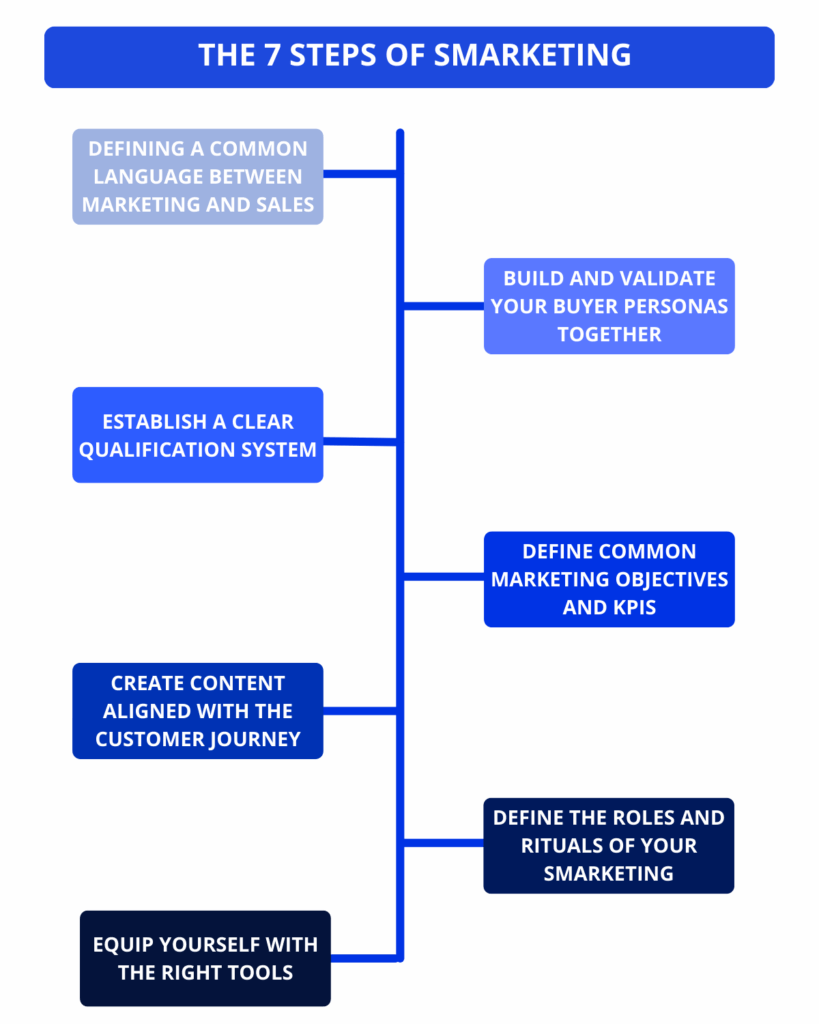
Step 1: Define a common language between marketing and sales
If you ask your marketing team what an MQL is, and then ask the sales team the same question, you will very often get… two different answers 😅. And as long as everyone uses their own definitions, you create gray areas that slow down your pipeline. Your first task is therefore to align key terms. This includes, for example 👇🏻:
- MQL (Marketing Qualified Lead): At what point is a lead “ready” for sales?
- SQL (Sales Qualified Lead): What criteria validate that they deserve an appointment?
- ICP (Ideal Customer Profile): Which companies REALLY match your ideal customer?
- Pipeline: What are the exact stages and their definitions in your organization?
Also clarify responsibilities and handovers. That is to say 👇🏻:
- Who validates that a lead is sufficiently qualified?
- When does it move from marketing to sales (and vice versa)?
- What happens if a salesperson rejects an MQL? How do they document this rejection?
- “What should marketing do if a lead becomes a cold lead again” after a call?
The goal is simple: you need to avoid gray areas and streamline the movement of leads without unnecessary discussion. 📣
Step 2: Build and validate your buyer personas together
Creating buyer personas is often considered a marketing task. However, if sales doesn’t validate these personas, you risk building a target audience that doesn’t reflect reality in the field. The persona must be co-created, with marketing providing the data-driven vision and the sales team providing the reality of everyday life. Why is this essential? Because salespeople know better than anyone 👇🏻:
- What questions come up in the first calls?
- What customer objections block deals?
- What criteria make a prospect buy… or never buy?
- Which companies are perfect ICP, but also which ones should be avoided?
When you combine these field insights with marketing data, you get reliable, actionable, and, above all, profitable personas.
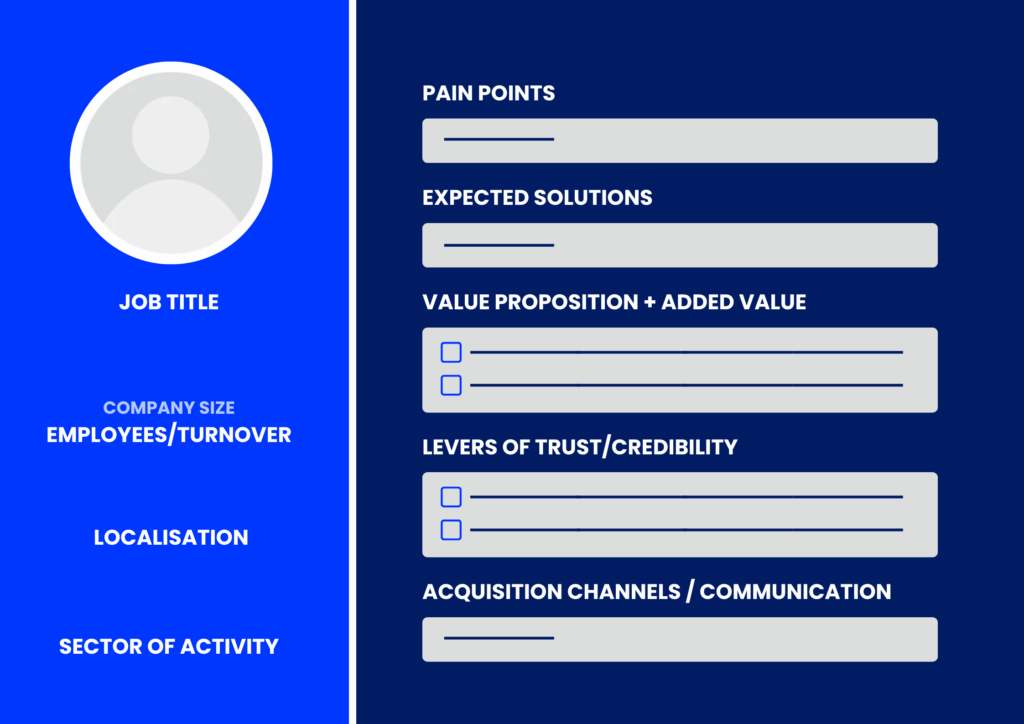
How can you avoid personas that are disconnected from the pipeline?
Here’s the golden rule: your personas should always be based on real data, not assumptions or internal discussions. To do this, rely on your wins/losses from the last six months, your recorded conversations (Call Review), your successful campaigns, your CRM history, signals of interest on your site, etc. 🔍.
Plan a marketing-sales workshop every six months to update your personas. Markets evolve quickly, and so do your targets.
Step 3: Set up a clear qualification system
To prevent marketing from sending “what it considers qualified” and sales from sorting “in their own way,” you need a simple, shared system.
- Define relevant scoring criteria: Good lead scoring always combines profile (ICP fit) and behavior (intent).
- Standardize the transition from marketing to sales: An MQL becomes an SQL when it meets jointly defined criteria: minimum score, good fit, and recent engagement. The goal is to avoid interpretation. A simple marketing SLA may suffice, for example: “When a lead reaches X points and matches the ICP, it is forwarded to sales within 24 hours.”
- Structure lead acceptance or rejection: Upon receiving an MQL, sales must be able to accept it… or reject it with a clear reason. Without feedback from the field, marketing cannot improve its qualification process.
For example, if several leads are rejected because they are not decision-makers (“) or because they are not the right target audience (”), you can immediately adjust your forms or targeting.
Step 4: Define common smarketing goals and KPIs
When marketing and sales follow different performance indicators, each moves in its own direction… and you lose performance 😅. Here is a table that shows the categories of KPIs to follow together:
| KPI category | Objective | Examples of indicators |
|---|---|---|
| Generation KPIs (Marketing) | Attract the right leads | MQL volume, cost per lead, engagement rate, and % of ICP leads. |
| Conversion KPIs (Sales) | Effectively convert leads | MQL/SQL rate, no-show rate, win/loss, and sales cycle length. |
| Cross-functional KPIs (Alignment) | Measure marketing-sales collaboration | Overall MQL/SQL rate, SLA compliance, pipeline, lead recovery rate, and follow-up speed. |
Step 5: Implement content strategies aligned with the customer journey
Your content should accompany your prospects from initial interest to decision-making. To achieve this, marketing cannot work alone; sales teams hold valuable information that can be used to create truly useful content.
1) Align content with the customer journey
Marketing identifies topics that attract, but salespeople know what blocks or advances a deal.
- 🧭 Awareness: Articles, guides, and posts that answer initial questions.
- 🤔 Consideration: Comparisons, use cases, responses to objections.
- 🏁 Decision: Demos, proof, ROI, and concrete examples of implementation.
2) Incorporate field feedback into the editorial
Sales teams have access to the actual phrases used by your prospects. By incorporating these quotes into your content, emails, or outbound marketing sequences, you make your communication much more realistic. And this is reflected in higher click-through rates, longer engagement, and better qualification.
3) Co-create outbound and nurturing sequences
When marketing and sales create messages together, you avoid inconsistencies between what the prospect reads… and what they hear on the call. You can:
- Segment leads based on their actual behavior.
- Adapt follow-ups according to the stage of the journey.
Your content must be marketing-oriented, useful, and operational. This is what creates a smooth journey for your prospects.
Step 6: Clearly define the roles and rituals of your smarketing
To truly align sales and marketing teams, everyone needs to know exactly what they’re responsible for and when to step in. Without this clarity, even the best processes eventually stall. Clarify everyone’s roles:
- 🎯 Marketing: Lead generation, qualification, and nurturing.
- 🤝 Sales: Handling, advanced qualification, closing.
- 🔧 Ops: Consistency of tools, processes, and automation.
Next, set up a few simple rituals: a weekly pipeline meeting to align priorities, a monthly review to analyze KPIs, and a session to adjust personas, messages, and scoring.
Finally, formalize a shared mini roadmap. Even a simple Notion document is enough to ensure that everyone is working toward the same goals and understands the actions underway.
Step 7: Equip yourself with the right smarketing tools
Good alignment also relies on a stack of sales and marketing alignment tools that truly connects marketing and sales. At a minimum, you need to implement:
- 🗂️ A CRM: The basis for tracking the pipeline and centralizing information.
- 🤖 An automation tool: For nurturing, prospecting, and follow-up emails.
- 📚 Sales enablement resources: Playbooks, templates, and ready-to-use content.
How does Waalaxy streamline your sales and marketing alignment?
With its “Team” plan, Waalaxy makes sales and marketing alignment using one tool effortless, giving both marketing automation and sales rep workflows a clean, unified pipeline with no information loss and a perfectly smooth handoff between marketing and sales 🔗
- 🧲 Centralization of generated leads: All your leads automatically arrive in the same place. No more Excel, no more manual imports, no more lost prospects.
- 🤖 CRM synchronization + automated follow-ups: As soon as an MQL is ready, it goes into your CRM, and Waalaxy triggers the right follow-ups by email, LinkedIn, or follow-up. No lead is left behind.
- 🎯 Fast and reliable ICP segmentation: In just a few clicks, you can isolate LinkedIn profiles that truly match your ICP, sorted by tags. Salespeople only receive high-potential buyers.
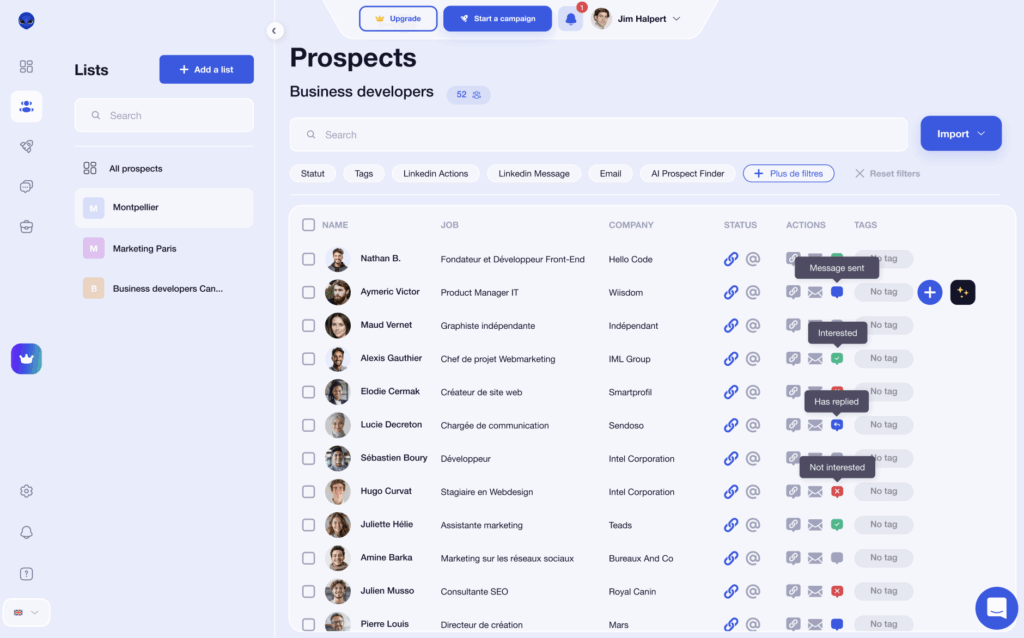
- 🤝 Joint campaign plan: Marketing and sales align their messages, sequences, marketing strategies, and the sales process, so the prospect experiences a consistent journey from start to finish.


Shall we recap sales and marketing alignment?
B2B marketing and sales alignment is not a bonus project; it’s a prerequisite for avoiding lost leads, misunderstandings, and messy pipelines 🧩. With clear definitions, common KPIs, and a few simple rituals, you can create real team dynamics and align your marketing and sales teams.
And with a tool like Waalaxy, you can apply sales and marketing alignment best practices effortlessly, streamline the handoff between teams, gain speed, and secure every follow-up. Two teams, one pipeline, one common goal: growth. 🚀
Frequently asked questions about sales marketing alignment
How to start smarketing if your company is starting from scratch?
If you’re starting from scratch, keep it simple: bring together your marketing and sales teams to define what an MQL, an SQL, and your buyer persona are. This is the absolute basis for avoiding misunderstandings and starting to speak the same language 🎯. Then add a short weekly meeting (15–20 minutes) to follow up on leads and understand what’s really blocking progress in the field 🤝.
If you’re short on resources, don’t panic. A clear pipeline, 2–3 common KPIs, and proper tracking of accepted and rejected leads are enough to lay the foundation. You’ll usually see the first effects of smarketing in 3 to 6 weeks.
Questions to ask before implementing smarketing
Before launching a smarketing strategy, it’s essential to make sure your foundations are solid. These questions will help you assess whether your organization is ready—or if you need to strengthen a few areas first 😎.
- Do your marketing team and your sales team share the same definitions of an MQL, SQL, and your ICP?
- Do you clearly know where your leads are getting stuck in the pipeline today?
- Are you receiving consistent, actionable feedback from your sales team?
- Have you defined performance indicators that are truly shared between marketing and sales?
- Do your tools (CRM, marketing automation, prospecting) communicate properly with each other?
- Do you already have recurring touchpoints between marketing and sales (weekly, monthly)?
- Do you know which steps you want to automate first to reduce lead loss?
Now you know everything there is to know about how to align sales and marketing and how to implement it.
 Lisa
23/01/2026
Lisa
23/01/2026