

- What is lead qualification, and Why Does It Matter?
- Why is lead qualification essential?
- The main lead qualification framework
- How to qualify sales leads ? The 4 Essential Steps
- How can you measure and optimize lead qualification?
- How to Automate Lead Qualification
- Let’s go over how to qualify a lead ?
- Frequently Asked Questions
You’ve got leads… but only a few turn into customers? 🤔
The problem usually isn’t volume, it’s lead qualification.Today, success isn’t about generating more leads… it’s about focusing on the right ones. 💥
In this article, you’ll learn how to master lead qualification process in just 4 simple steps, so you can stop wasting time and focus on the leads that are actually ready to close. 🕺🏻
What is lead qualification, and Why Does It Matter?
Lead qualification is the process of determining which leads actually deserve your time and which don’t. 🫠
When done right, it boosts your conversion rates and improves your ROI. When done wrong, it clogs your pipeline with false opportunities. 🥲
Let’s start by laying the groundwork.
What is a sales qualified lead ?
A qualified lead is a contact who has shown interest in your offer but hasn’t become a customer yet. 🙃
➡️ A lead: a raw contact who has entered your sales funnel.
Your goal? Turn your leads into real sales opportunities for your team. 🎯
What are the different qualification levels?
Not all your contacts have the same value. 💎
That’s why a strong lead qualification process helps you prioritize the right opportunities.
Here’s how to differentiate them:
| Level | Definition | Example | Action to Take |
|---|---|---|---|
| Lead | Raw contact, unqualified or lightly qualified | Downloads an ebook or fills out a form | Nurture with emails, content, and follow-ups |
| MQL (Marketing Qualified Lead) | Lead showing clear interest and engagement | Clicks emails, visits pricing pages, interacts multiple times | Score, segment, and prioritize |
| SQL (Sales Qualified Lead) | Qualified lead with real business potential (need, budget, timing) | Identified need + budget + timeline | Contact quickly and move to sales |
Your SQLs are your highest-value leads, the ones most likely to convert. Focus on them, and you’ll close more deals with less effort. 🎯
When should you qualify a lead?
As early as possible… but not just once. 🫠
The moment a contact enters your funnel, you should start your lead qualification to filter out irrelevant leads. But that’s only the beginning. Over time, a lead can evolve, shift priorities… or disappear entirely. 🙃
So keep this simple rule in mind: qualification is an ongoing process. 🔄
Why is lead qualification essential?
If you feel like you’re not closing enough deals, the issue isn’t always your pitch it’s often your lead qualification process. You’re generating more leads… but not better ones. 😣
The problem with unqualified leads
You have leads. But how many are actually worth pursuing?
In many sales teams, poor lead qualification creates a snowball effect : too many leads to handle, sales reps spending their time filtering, and opportunities that aren’t really opportunities. 😔
You end up with frustration, wasted time… and sales performance that stagnates or declines. 📉
Your team isn’t underperforming because they lack skills they’re just spending time on the wrong prospects. 👀
The Impact on the your Pipeline and Conversion
A poorly qualified pipeline creates a false sense of performance. On paper, everything looks fine: plenty of opportunities, a full funnel… 🌪️
But in reality, few deals actually close. You’ve got volume, but no results.
Conversely, a well-qualified pipeline allows you to 👇🏻:
- Shorten the sales cycle.
- Improve the closing rate.
- Increase revenue.
Fewer opportunities, but far more qualified leads that actually close. 📊
Lead generation vs. lead qualification: What’s the difference?
This is often where it all comes down to. Many teams focus on lead generation… but overlook lead qualification. Here are the differences: 👇🏻
| Lead generation | Lead Qualification |
|---|---|
| Goal: volume | Goal: Quality |
| Fill the funnel | Filter the funnel |
| Marketing focus | Marketing and sales alignment |
| KPI: Number of leads | KPI: conversion / revenue |
| Risk: Unqualified leads | Benefit: more qualified deals |
| Result: inflated pipeline | Result: profitable pipeline |
The main lead qualification framework
When it comes to lead qualification, three frameworks stand out: BANT, CHAMP, and MEDDIC.
They all serve the same purpose: helping you structure your conversations and quickly determine whether a lead is worth pursuing… or not. 😉
Here are the most widely used lead qualification frameworks:
- BANT Method (Budget, Authority, Need, Timing): A classic sales lead qualification framework. You quickly assess whether the lead has the budget, decision-making power, a clear need, and the right timing.
Ideal for moving fast… but sometimes a bit too basic. ⚡ - CHAMP Method (Challenges, Authority, Money, Priority): Here, you start with the qualified lead’s challenges before discussing budget. More aligned with a consultative and customer-centric approach. 🧠
- MEDDIC sales Method (Metrics, Economic Buyer, Decision Criteria, Decision Process, Identify Pain, Champion): A highly structured method that covers the entire decision-making process. Perfect for complex sales cycles but requires rigor. 📊
The Limitations of Traditional Lead Qualification Methods
These frameworks are useful but they’re not perfect. especially if you don’t apply proper lead qualification best practices. First, they’re often used like rigid checklists. You ask the “right” questions… without really listening to the answers. 📋
Second, they don’t always reflect how leads actually behave:
- Engagement. 👍
- Buying signals. 🗣️
- Interactions. 🩷
Because in the end, they can give you a false sense of lead qualification. A lead might check every box… and still never buy. ⚠️
How to qualify sales leads ? The 4 Essential Steps
Now that you’ve got the basics, let’s get practical. 🤓
Qualifying leads isn’t about intuition. It’s a structured process that helps you determine if an opportunity is worth the effort. You only need four steps! 🤩
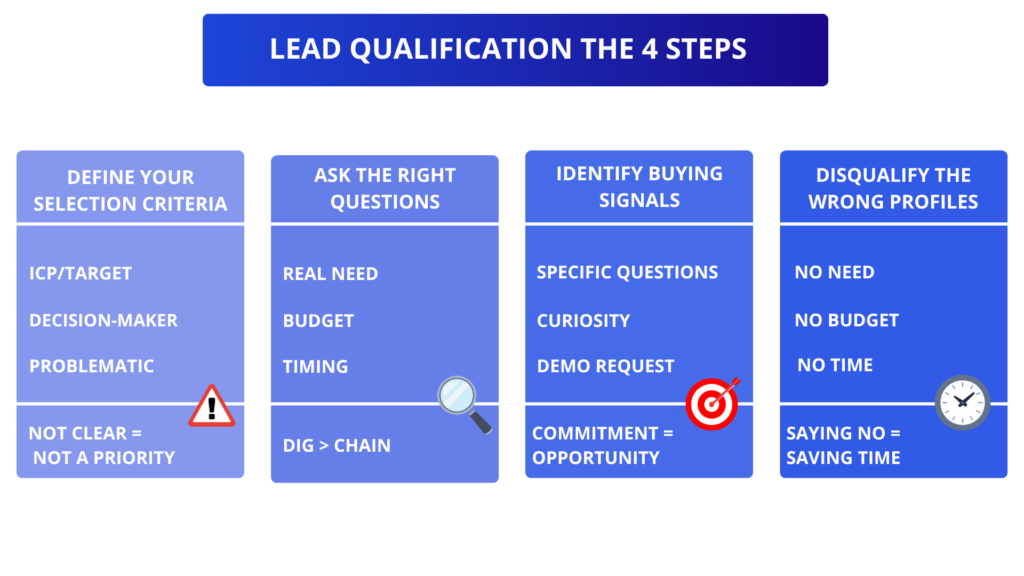
Step 1: Define your Lead qualification criteria
Before you even speak to a lead, you need to know what you’re looking for and that often starts with qualifying a prospect list.
A qualified lead isn’t just someone who’s interested, it’s someone who already meets clear lead qualification criteria and shows real business potential. 💰
To get there, you should be able to quickly answer these questions:
- Does this contact match your ideal customer profile (ICP)?
- Are they a decision-maker or close to one?
- Do they have a real problem you can solve?
- Is there actual business potential (budget, stakes, impact)?
If you hesitate or the answers aren’t clear, that’s usually a red flag.
⚠️ This isn’t (yet) a truly qualified lead… and definitely not a priority.
Step 2: Ask the right lead qualification questions
In many cases, the problem isn’t with the lead… but with the discovery process. You ask questions, but you stay on the surface. You think you’ve found a customer… when you haven’t.🥲
Your goal is to understand the lead’s real situation not just what they say in the first conversation :
- Start by digging deeper into the need 🔍: A simple “we’re looking for a solution” isn’t enough. You need to understand what’s driving the search, the impact of the problem and what’s already been tried. That’s how you separate curiosity from real intent.
Why are you looking for a solution now?
What happens if this problem isn’t solved?
What have you tried so far?
- Talk about budget and readiness 💰: Yes, it can be uncomfortable. A lead who’s interested but not ready (or able) to invest is still a weak opportunity. You need to know if they’re ready to act… or just exploring.
Has this project been budgeted?
How are decisions like this made internally?
Who’s involved in the decision?
Are you actively comparing solutions or just exploring?
- Think about timing ⏳: A good fit, but in 6 months ? That’s not a priority. You need to understand when decisions will be made and what could accelerate or delay them.
Do you have a specific deadline or trigger event?
What could speed up the decision-making process?
⚠️ Finally, avoid common mistakes like talking aboutthe product or service too early, skimming over answers, or avoiding sensitive discovery questions like budget or decision-making.
How many questions should you ask to qualify lead?
There’s no magic number. 🧙🏻
But in most cases, 5 to 10 well-targeted lead qualification questions are more than enough. Ask too many, and it starts to feel like an interrogation… Ask too few, and you miss critical insights.
It’s all about balance. 😅
Step 3: Identify buying signals
Not all qualified lead will clearly tell you “ “I want to buy ”.” But they do send signals. You just have to spot them, understand them, and read between the lines. 🫠
Some signals are clear and hard to miss 👇🏻:
- Specific questions about your solution (features, integrations, ROI)
- Involvement of other decision-makers in the conversation
- Requests for a demo, trial, or pricing
But there are also more subtle signals, such as the lead responding quickly and engaging in the discussion, imagining your solution in their context (“If we implement this… ”) or they talk about next steps. 😉
Examples of buying signals:
– “How does implementation work?”
– “Does this integrate with our current tools?”
– “When could we get started?”
🔎 These signals show that the lead is moving from simple interest… to real buying intent.
Step 4: Filter out the bad leads
This is the most overlooked step of this lead qualification checklist and often the most profitable.
The natural instinct is to push every lead forward. But in reality, you lose more by chasing bad opportunities than by dropping them early. 😔
👉 Strong lead qualification also means knowing when to say no. Here are clear red flags :
- The need is vague or not a priority.
- There’s no budget (or not anytime soon).
- The timeline is too far out.
If you keep pushing under these conditions, you’ll clog your sales pipeline with deals that will never close.
Stopping a deal doesn’t mean losing it forever. You can keep the relationship warm through nurturing and re-engage when the timing is right. 😎
How can you measure and optimize lead qualification?
Qualifying sales leads is good. Measuring it is what actually drives improvement.
Without data, you’re relying on gut feeling. With the right KPIs, you understand what works and more importantly, what’s costing you deals. 📉
What’s the Most Important KPI?
If you had to choose just one, it’s your lead-to-opportunity conversion rate. Because it directly reflects the effectiveness of your lead qualification process. 🤓
- Too low: You’re pushing poorly qualified leads to sales.
- Too high (but low revenue): you might be over-qualifying and missing opportunities.
One KPI isn’t enough to get the full picture.You should also track:
- The closing rate. 🛍️
- The sales cycle duration. ⭕️
- The disqualification rate. ❌
📊 Together, these metrics give you a clear view of your performance and help you quickly identify what needs to improve.
The role of lead scoring
Lead scoring helps you automatically prioritize your leads.
Each lead gets a score based on their profile and behavior (engagement, interactions, level of interest).
That way, your sales and marketing team instantly knows who to focus on. 🧘🏻♀️
Effective scoring saves you time, prevents you from chasing cold leads, personalizes your approach, and improves your conversion rate. It’s essential as soon as you start generating volume.⚙️
The role of lead routing
Lead routing comes right after lead qualification.
Its role is simple: assign the right lead to the right sales rep based on criteria like industry, company size, or maturity level. 😇
You waste less time, get faster responses, and have a better chance of closing the deal.The faster a qualified lead reaches the right person, the more likely it is to convert.⏱️
How to Automate Lead Qualification
As soon as you start generating volume, one thing becomes obvious: you can’t qualify every lead manually.
That’s where automation comes in. It helps you filter, prioritize, and focus your efforts on high-potential leads so your team spends time where it actually matters. 😎
Can Lead qualification be automated?
The goal isn’t to replace sales reps. It’s to make them more efficient. You can automate key parts of your lead qualification process, such as:
- Sorting leads based on profile data (industry, role, company size).
- Analyzing their behavior (click-through rates, responses, interactions).
But understanding real needs and building relationships? That still requires a human touch. 🤝
How to use automated Lead Qualification to streamline your process ?
Before automating anything, you need a solid foundation:
- Clear B2B lead qualification criteria.
- Defined steps.
- Prioritization rules.
Otherwise, you’re just automating a broken process.😔
Once this foundation is in place, automation streamlines your pipeline, fewer oversights, greater responsiveness, and better lead prioritization.
Companies that respond to a lead within 5 minutes are up to 9x more likely to convert.
➡️ The goal isn’t to complicate your process, it’s to make it faster, more reliable, and more efficient every day.
What lead qualification tool should you use ?
A CRM alone isn’t enough once you start scaling. That’s where a tool like Waalaxy comes in. 🧐
Built for B2B sales prospecting, it goes beyond static data by focusing on real-time behavior. With it, you can:
- Track interactions (responses, clicks, engagement).
- Automatically identify the most interested leads using scoring.
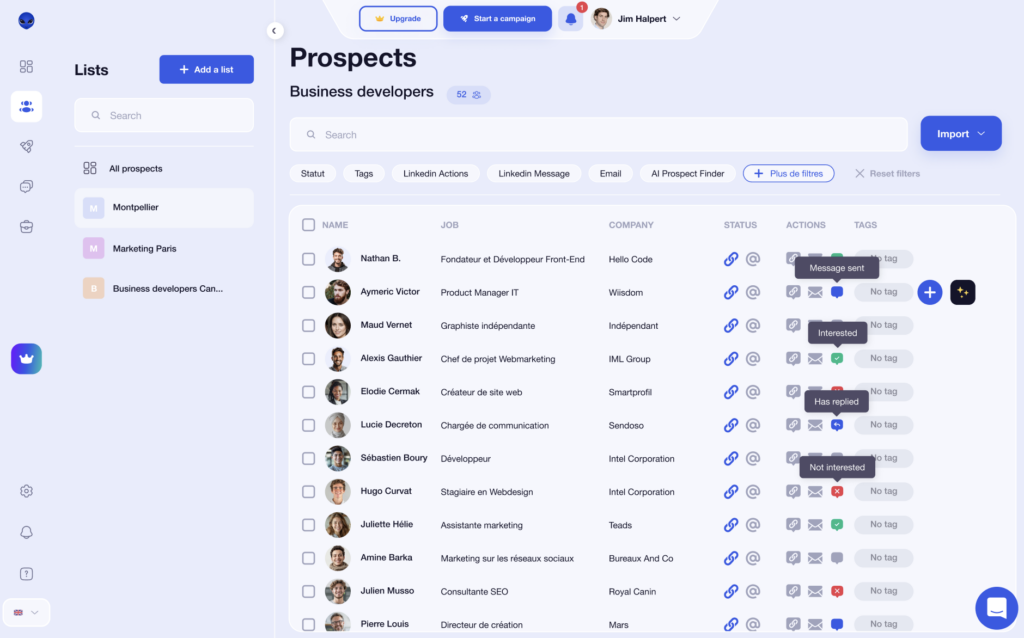
- Automate your outreach via LinkedIn and email.
- Stay in touch via the Waalaxy inbox.
- Connect your preferred CRM.
Stop reaching out to everyone… and start focusing on leads that actually have potential. 🔥
Let’s go over how to qualify a lead ?
You can generate hundreds of leads… but without proper lead qualification, you’ll waste time, energy, and opportunities. 🫠
The real challenge isn’t just booking meetings, it’s focusing on qualified leads with real potential. 😌
Strong lead qualification leads to :
- A cleaner pipeline.🧹
- Shorter sales cycles. 🧘🏻♀️
- More deals closed. 💰
At the end of the day, your performance isn’t driven by how often you say “yes”… but by how quickly you can say “no” to the wrong leads.
Frequently Asked Questions
Should you qualify all your leads?
No, and that’s exactly where many teams go wrong.
Trying to process every lead is the fastest way to dilute your lead management efforts. Not all leads have the same value or the same priority. ⚠️
What are the 4 types of customers?
In practice, you’ll often encounter 4 customer profiles👇🏻:
- The Urgent One: They have an urgent need and want to move quickly.
- The Hesitant: Interested, but not yet convinced.
- The Explorer: They’re gathering information, with no immediate intention to buy.
- The unqualified: No real need or no fit.
The goal is to identify these profiles quickly, so you can adapt your approach and focus on the right opportunities. 😏
How do you assess a lead ?
Lead qualification isn’t about interrogating your leads. If you fire off questions without adding value, you risk creating friction, mishandling sales objections… or even losing their interest.
Instead, turn qualification into a real conversation:
- Rephrase their challenges to show that you understand. ☺️
- Share an insight or feedback. 🤩
- Challenge certain points to help them clarify their situation. 🤓
How do I qualify as a lead?
You don’t really “qualify yourself” as a lead the qualification happens based on how you interact with a company. From a business perspective, a lead becomes qualified when their actions show real interest and forward momentum.
➡️ For example, a lead is more likely to be considered qualified if they:
- Engage consistently (emails, content, conversations).
- Ask concrete questions or request next steps.
- Show signs they’re moving toward a decision.
Now you know how to qualify a lead. 🧚🏻♀️
 Cécile PANZANI
03/04/2026
Cécile PANZANI
03/04/2026